
South Africa’s new energy vehicle (NEV) debate has shifted from climate talk into the hard economics of geopolitics, fuel volatility and consumer survival.
It has accelerated interest in NEVs and given fresh urgency to a market that was slowly shifting towards electrification.
Economist and professor at the Gordon Institute of Business Science (GIBS), Adrian Saville, says the geopolitical effect is immediate and structural. “South Africa does not set the oil price, does not control the rand, and cannot influence geopolitical decisions,” he says.
“This goes beyond being a single, narrow shock. Rather, it’s a structural repricing that hits an economy that is already stretched.”
Saville warns that the fuel crisis is already cannibalizing growth. “Diesel moves goods, and goods cost more when diesel costs more,” he says. With inflation tracking toward 5.0% and the South African Reserve Bank (SARB)’s rate hike in May, household balance sheets are under siege.
“The consumer who cannot afford a R700,000 ($42,321) EV today cannot afford it when petrol is R30 ($1.80) per liter either,” Saville asserts. “Without deliberate policy targeting middle-income buyers, the transition will deepen transport inequality rather than reduce it.”
While the luxury segment has historically defined the local EV market, the ‘petro shock’ of 2026 is creating a vacuum that Chinese automakers are filling with calculated aggression.
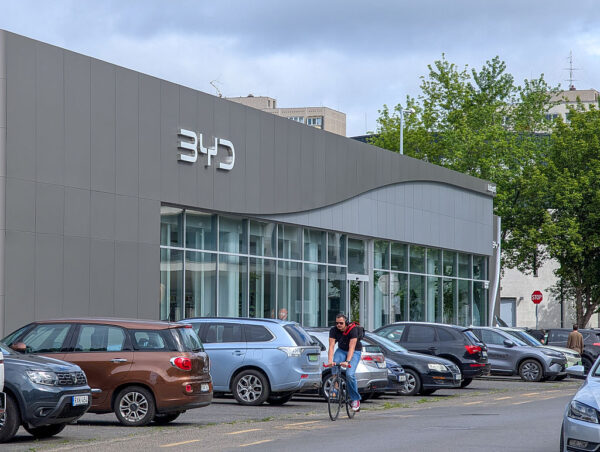
For the first time since its 2023 launch, BYD South Africa has released its sales figures to Naamsa, the Automotive Business Council in South Africa, and the data is a revelation.
In March 2026 alone, BYD sold 589 units. To put that in perspective, Mercedes-Benz, a titan of the local luxury landscape, sold 595 units in the same period.
Fifty percent of BYD sales in Q1 2026 were plug-in hybrid electric vehicles (PHEVs), which ties in to a trend seen in NEV sales for South Africa in 2025. According to Naamsa, PHEV sales grew from 738 units in 2024 to 2,808 in 2025, which represents a staggering 280% year-on-year growth.
Collectively, the top five automakers on that list include Chinese brands Chery, Haval, and Omoda & Jaecoo, that sold 1,789 units, while BMW sold 681, followed by Volvo, now Chinese-owned, at 174.
Decentralized Resilience
Bronwyn Williams, a futurist and partner at Flux Trends, views this moment as the “unraveling of the world order”. She argues that South Africa’s dependence on legacy systems like the petrodollar is a strategic weakness.
“This moment should hasten all efforts to secure power and energy at a national level, by investing in a diversified (and decentralized) energy mix,” Williams says.
She notes that while South Africans usually respond to forced change with “resilience”, metaphorically replacing a taxi steering wheel with a spanner, the current crisis is pushing the middle class toward “choice switching”.
“Choice switching is reaching a tipping point where energy supply is finally stable enough, vehicle prices are finally low enough, and oil prices now high enough to make EVs economically sustainable for cash-strapped consumers,” says Williams.
However, she believes an EV is only as good as the juice that powers it. “In a country where the national grid remains a ‘dirty little secret’, still running roughly 7% on diesel, the push for off-grid solutions has become a commercial imperative.”
The Infrastructure Frontier
Joubert Roux, co-founder and chair of Zero Carbon Charge, is currently rolling out South Africa’s first off-grid, solar-powered public EV chargers. For Roux, the math is simple: EVs can be approximately 30% cheaper to maintain and deliver energy cost savings of more than 50% compared to internal combustion engines (ICE).
“Range anxiety is still a factor, but it is evolving,” Roux explains. “It is less about battery range and more about confidence in the network. As infrastructure becomes visible and reliable, range anxiety tends to disappear.”
Roux highlights a critical shift in 2026: the electrification of freight. Heavy-duty transport is under immense pressure from diesel volatility, making electric trucks an “economic necessity rather than a future option”.
“Electric trucks require large volumes of reliable, high-power energy… something the grid cannot consistently provide at scale,” Roux adds. “By building off-grid, solar-powered charging infrastructure along key logistics corridors, [we are] removing dependence on both the grid and oil.”
Policy vs. Reality
Despite the organic surge in interest, the industry remains frustrated by “policy inertia”. Roux and other leaders continue to call for the removal of the ad valorem (luxury) tax, which treats EVs as high-end toys rather than strategic technology.
Saville agrees that the financing environment is a hurdle. “South Africa’s high interest rate environment means the fuel saving can be neutralized by borrowing costs alone,” he says. For EVs to reach true cost parity by 2030, financing costs would need to fall significantly; a move that requires a level of government commitment that has yet to materialize.
As we move further into 2026, the convergence of three forces: rising energy volatility, improving EV economics, and infrastructure deployment, is rewriting the South African automotive playbook.
The entry of value-driven brands like BYD and Geely, which launched what is currently South Africa’s cheapest EV, the Geely E2 starting at R340,000 ($20,557), paired with the expansion of Zero Carbon Charge’s infrastructure, with two strategically placed EV chargers launching on the N3 between Johannesburg and Durban in June, suggests the ‘great unraveling’ of the ICE era is underway.
South Africa may have been forced into this innovation by a distant war, but the result is a domestic pivot toward energy independence. Our EV shift is no longer just about cleaner mobility; it’s about who can afford certainty in a volatile world.
Originally published in Forbes Africa Jun/July 2026.


Recharged is an independent site that focuses on technology, electric vehicles, and the digital life by Nafisa Akabor. Drawing from her 19-year tech journalism career, expect news, reviews, how-tos, comparisons, and practical uses of tech that are easy to digest. Nafisa is a traveller at heart, having been to 46 countries and counting. Find her edutainment videos covering tech, EVs and travel on TikTok.