
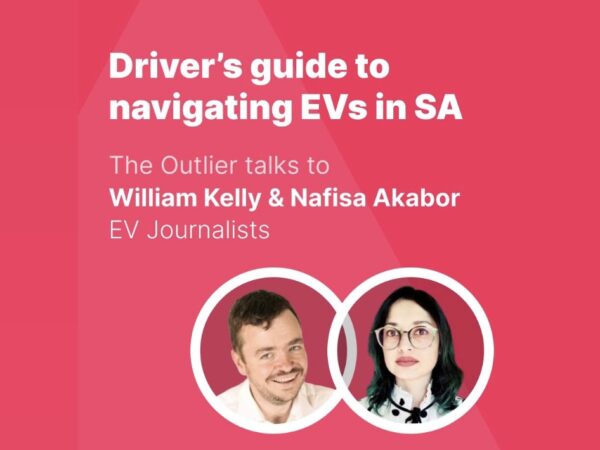
Last week I was a guest on The Outlier’s webinar on their topical subject of EVs. It was hosted by Gemma Ritchie. Here’s a recap and repost from their summary.
The Outlier’s latest Out to Lunch webinar tackled electric vehicles, and two seasoned EV journalists, William Kelly and Nafisa Akabor, spent an hour answering the questions South African buyers actually ask. Below are the practical tips they offered, drawn from years of testing cars.
Driving is different, but you adjust fast
The first surprise for new EV drivers is silence. Akabor recalled switching an EV off by accident, mistaking the quiet for the engine not starting. Kelly’s advice: get used to instant torque before you put your foot down flat. EVs deliver full power the moment you accelerate, unlike a petrol engine that needs to spin up. That makes them feel far quicker off the line, and it catches new drivers out.
Some cars have gone further than silence. Certain models don’t need a physical key at all: a phone or smartwatch can unlock and start the car, and newer Chinese models are introducing facial recognition. The practical tip here is mundane but important: don’t let your phone or watch battery die if it’s your only way into your car.
Price, not tech, is what moves the market
Both panellists agreed that South Africa’s EV hesitancy has mostly been a pricing problem. Kelly pointed to Norway, which reached 96% EV penetration once government policy made EVs cost the same as equivalent petrol cars. South Africa hasn’t done that, and import duties are steeper for EVs (25%) than for petrol or diesel vehicles (18%), a gap both panellists want scrapped.
What’s shifting things now is the arrival of cheaper Chinese brands. Akabor named the BYD Dolphin Surf and the Geely EX2, both around R340,000, as the cars finally bringing EVs into the price bracket where most South Africans actually shop. She noted that 64% of new cars sold locally go for under R400,000, and until recently, only a handful of EV models competed in that segment.
Plug-in hybrids are a stepping stone, not a destination
For buyers nervous about going fully electric, plug-in hybrids look like a safe middle ground, and sales grew 280% year-on-year in 2025. But Kelly cited a French survey in which most plug-in hybrid owners said, in hindsight, they’d have preferred to buy a full EV. His practical framing: PHEVs make sense for single-car households doing regular long-distance trips, but once you’ve lived with one, going back to a petrol station regularly gets tiresome.
Real-world range depends on how you drive
Claimed range figures vary by testing standard, and Kelly said the European standard tends to match South African real-world conditions most closely. Beyond that, range comes down to driving style, terrain, aircon use, and whether you stay in eco mode. Akabor’s tip: use the drive mode settings. Switching to eco caps acceleration and climate control automatically, which is a simpler way to preserve range than manually adjusting settings.
Car design matters too. Kelly flagged aerodynamics and battery size as the two biggest factors in range, warning that boxy, heavy EVs will always underperform sleeker equivalents with the same battery.
Batteries last longer than buyers expect
This was one of the most reassuring parts of the discussion. Manufacturers typically offer eight-year battery warranties, and real-world data from markets with longer EV histories shows batteries degrading by roughly 2% a year, well inside warranty terms. If a battery drops below 70% state of health inside the warranty period, it gets replaced for free.
For anyone considering a secondhand EV, ask for a state-of-health report and check for cell voltage imbalances before buying. And don’t expect to find many secondhand EVs on the market yet. Akabor noted owners tend to keep them in the family rather than sell, because they’ve seen how cheap they are to run.
Old batteries aren’t wasted either. Once a car battery drops to around 70% health, it can go into a “second life” as home battery storage, where the load is far gentler than on the road, giving it years more use before recycling. South Africa already has a lithium-ion recycling facility running in Johannesburg.
Charging: home is cheapest, complexes are the challenge
Home charging is roughly a quarter of the cost of petrol, and public charging around half, according to the panellists’ rule of thumb. Akabor gave a concrete example: charging a Geely EX2 (39.4kWh battery) at home cost her R106 for around 300km of range, versus R232 to R290 on public AC or DC chargers.
You don’t need a wall-mounted home charger to start. A standard three-pin plug works, just slower, roughly 20 hours for a full charge from empty on a 40kWh battery. The practical fix, both panellists said, is to treat it like a phone: plug in overnight and don’t worry about full depletion.
The real gap is for people in complexes who aren’t allowed to install home chargers. Their advice: check which dealerships nearby offer free charging (BMW and Mini both do, for a limited period after purchase) as a stop-gap while public infrastructure and body-corporate rules catch up.
Maintenance costs are the quiet selling point
With fewer than 20 moving parts and regenerative braking that spares brake pads, EVs need little beyond topping up coolant and wiper fluid. Both panellists were blunt that this, more than performance or tech, is where EVs consistently beat petrol cars on total cost of ownership. Tyres wear slightly faster due to the weight of the battery, but that’s about the extent of the added cost.
Their closing advice to anyone still on the fence: go and test drive one. Both said the range anxiety and charging-infrastructure worries buyers arrive with tend to disappear once they’ve actually driven an EV for themselves.
A recording of the webinar is available for Outlier members.
Originally published on the Outlier.
More EV content from Nafisa.


Recharged is an independent site that focuses on technology, electric vehicles, and the digital life by Nafisa Akabor. Drawing from her 19-year tech journalism career, expect news, reviews, how-tos, comparisons, and practical uses of tech that are easy to digest. Nafisa is a traveller at heart, having been to 46 countries and counting. Find her edutainment videos covering tech, EVs and travel on TikTok.