
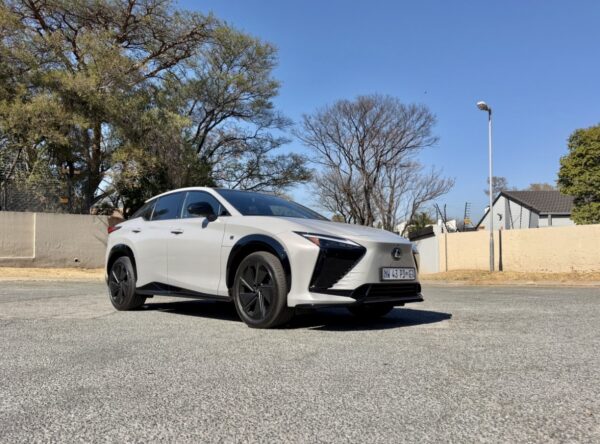
The Lexus RZ 550e F Sport stands out from other EVs. It’s spacious, opulent, comes at a price, and features a yoke instead of a conventional steering wheel. After a week of living with it, I don’t think it’s for everyone, but it’s definitely more than just a gimmick.
You may recall I spent a week with the Lexus RZ 550e SE back in April, you can catch up with that post here plus I attended the launch event in Cape Town for the Lexus RZ, which I covered for Brainstorm here.
This article forms part of my Living Electric series where I put EVs to the practical, real-world test and share data to help you decide if this is the EV that fits into your life. If you want info from a brochure, visit other websites or Lexus directly.
QUICK LOOK
- 300kW of power; 537.2Nm of torque
- Battery: 76.9kWh battery
- Claimed range: 450km
- 0-100km/h in 4.4 seconds
- Claimed consumption: 18.8khW/100km
- Price: R1.938 million
1. WHO SHOULD BUY THIS CAR?
The RZ 550e F Sport is not pretending to be an affordable entry point into EVs. At almost R1.94 million, it sits firmly in luxury territory. It’s aimed at someone who wants an EV, but doesn’t want to compromise on the things you’d expect from a premium Lexus: a beautifully finished cabin, plenty of technology, strong performance and a quiet, comfortable drive.

Think power couples in leadership roles, couples with teenagers or kids at varsity, or those nearing retirement but want to experience an EV in a luxurious way.
It’s also aimed at those who are prepared to embrace something a little different… because there is no missing the yoke. I’ll get more into that under City Driving vs. Open Road.
2. RANGE REALITY
I incorporated the RZ 550e F Sport into my everyday life rather than taking it on a road trip as I don’t have the luxury to do that with every test car. That meant working from home, running errands, attending events and generally going about my business.
The battery was on 97% when I received it, and the estimated range showed 328km. Before my charging stop, the battery had dropped to 64%, with 207km of estimated range remaining, meaning I had driven 128km and my consumption was 19.83kWh/100km, slightly higher than the claimed 18.8kWh/100km.
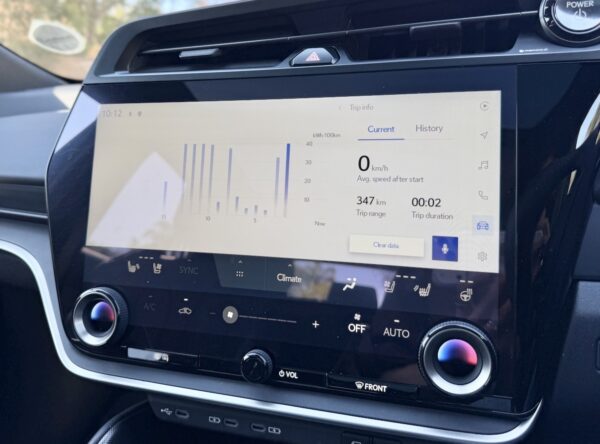
But by the time I charged the car to 100%, it showed 316km of estimated range, compared to the 328km when I received it at 97%. And when I returned the vehicle, my consumption per the dashboard was 20.8kWh/100km.
Given the car’s size and power, it was also nowhere near the claimed 450km of range. I think it’s safe to say the average realistic range for this vehicle is around 320km. This is due to the estimated range being constantly recalculated based on how the car has been driven.
Yes, I used the heated steering wheel and heated seats during a cold spell in Joburg. I loved driving the F Sport during the freezing temperatures. It provided the luxury and comforts expected from a Lexus.
When you’re driving this vehicle, you’re likely not worried about eco mode or skimping on the comforts it offers. The RZ is a substantial luxury SUV, and the F Sport prioritises performance as much as efficiency. If efficiency is a high priority when buying an EV, this isn’t going to be on that list.
3. HOME vs PUBLIC CHARGING
I only needed to charge the RZ once during my week with it, and because of time, I visited the Rubicon DC charger in Woodmead. But it didn’t go smoothly; the car initially gave me a “plug-in charging system malfunction” error.
I’ve encountered issues with Rubicon chargers on many occasions before, so I’m not sure if the problem was with the charger, the car or the interaction between the two. But thankfully, it eventually charged. When I got home, I tested it on my home charger, and didn’t have any issues. So I think that settles it.
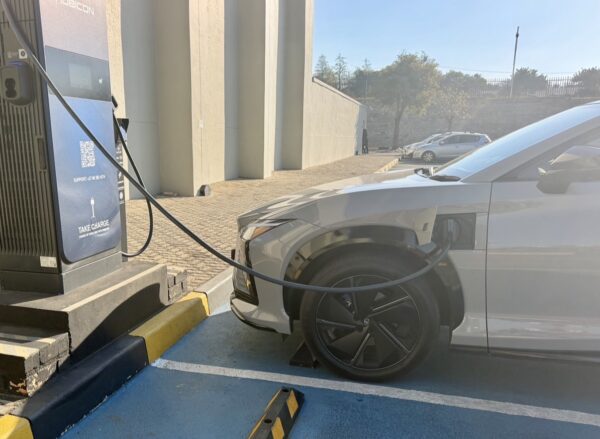
The session at Rubicon in Woodmead lasted 47 minutes and added 33.59kWh of charge to the battery. The maximum charging speed I achieved was 59.3kW. So at R7.35 per kWh, the session cost me R246.90.
Here’s what charging the battery from empty should cost, bearing in mind, it’s not possible to drain it to 0% before finding yourself at a charger (unless you get towed there):
- 76.9kW @ R2.69 via my Eskom rate = R206.86
- 76.9kW @ R5.88 public AC charger = R452.17
- 76.9kW @ R7.35 public DC charger = R565.21
- 76.9kW @ R8.24 Rubicon w/ GridCars Card = R633.66
- 76.9kW @ R9.15 Zero Carbon Charge = R703.63
Despite the large battery, it all comes down to your lifestyle and how many kms a day you do that would give you an indicator of how often you should charge it and where you charge. I think for regular usage it should be once a week or every 10 days if you rely on public charging or want a fast charge.
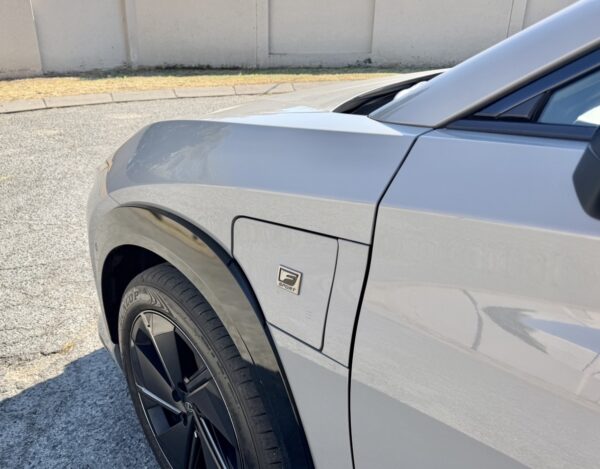
It would be different if you charge at home, and opt to buy a wallbox charger to install at home, as Lexus does not supply a wallbox charger. You do get the regular charging cables for home (3 pin plug) and the public AC charging cables.
The F Sport supports 22kW on-board charging, which is the maximum you get from AC charging on 3 phase power. If you have 3 phase power at home, it would make sense to get a wallbox charger installed and not have to worry about public charging.
4. LIVING WITH THE TECH
Inside, the RZ 550e F Sport feels like the luxury vehicle it is. There are roof blinds and other high-quality finishes with plenty of USB ports; it’s the attention to detail you’d expect at this price point.
However, physical buttons/controls are limited to the front and rear de-misters, and temperature controls, which are dual-zone.
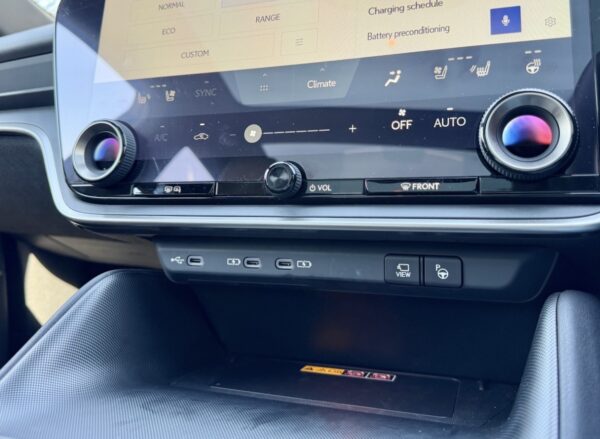
All other controls are digital on the touch-screen infotainment system. And then there are permanent touch controls beneath the main infotainment screen for things such as the heated and ventilated seats, expanded climate settings, heated steering wheel, fan speed and air conditioning power.
The main infotainment display sits alongside a digital instrument cluster behind the steering wheel, while there are also physical controls on the steering wheel itself.
And then there is the digital rear-view mirror. I appreciated this on cold mornings. There’s no rear wiper, and when the rear window was icy, visibility through the conventional mirror was poor. Switching to the HD camera view meant I could still see what was happening behind me, like when I reverse down my lengthy driveway. This is the type of tech I appreciate: not tech for tech’s sake, but something that solves a problem.
The smartphone test: one of my first tests in any new car is connecting my iPhone, because I’ve had mixed experiences with Toyota vehicles in the past, but the RZ just worked.
It connected on the first attempt and the whole process was seamless. It may sound like a small thing, but when you’re living with a car every day, small frustrations can become big ones. Thankfully, this wasn’t one of them.
5. ACCESSING THE DRIVING DATA
I’m gonna paraphrase here from my original Lexus 550e SE post as it’s the same thing: Access to driving data is crucial when driving an EV, especially since EVs rely heavily on software. The infotainment system could be improved to present data visually.
It lacks an effective interface for tracking driver data, and without tapping ‘update’ after each drive, the data isn’t visible. If you forget to update it then it feels like you’re missing out on the data for those periods.
This lack of historical data retrieval is frustrating, especially since I downloaded the Lexus app but couldn’t link the test car to it. Even under trip history, it only displayed current consumption levels and previous drives, not my previous drives.
But after driving the F Sport, I realised, in all honesty, when you’re driving this vehicle, you’re really not going to be concerned about how economical you are in this EV.
6. CITY DRIVING vs OPEN ROAD
The RZ 550e F Sport has plenty of performance on tap, making it fun to drive on the highways or urban roads, and that’s part of what makes my 20.8kWh/100km consumption figure understandable. However, you can toggle between normal, sport, eco modes etc.
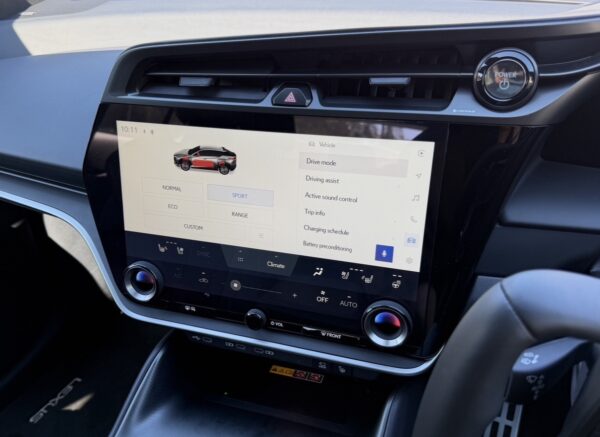
This isn’t an EV designed around squeezing every possible kilometre out of every kilowatt-hour. It feels quick yet composed, and the F Sport treatment gives it a sportier character than you’d expect from a large luxury SUV.
But that comes with a trade-off: you’re not buying this car because it is the most economical way to travel from A to B. You’re buying it because you want an electric Lexus that also happens to be fast, luxurious and different.
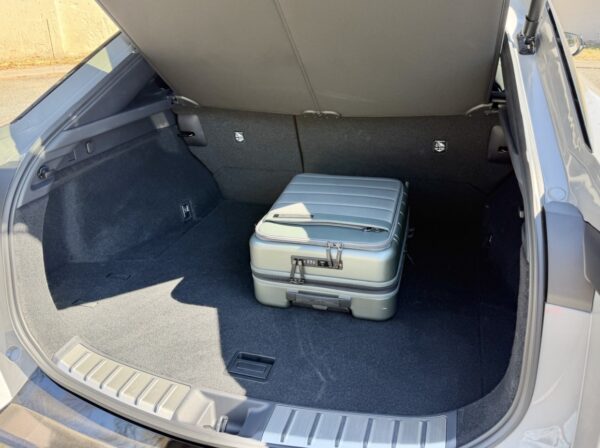
The boot size is 522L and this is what it looks like with my hand luggage inside. It does expand to 1451L when the rear seats are folded down.
The yoke steering wheel: When I first drove the 550e F Sport at launch, I was intrigued by the yoke steering wheel. After a week with it, I actually like it. It may surprise you to know how quickly it becomes normal. It’s like adjusting to a new OS phone keyboard layout, the more you use it with each day, the more comfortable you get with it (after initially hating it).
The steering is responsive at low speeds and, because of the steer-by-wire system, you don’t need to turn the wheel nearly as much as you would with a conventional steering wheel. There’s no need for the traditional hand-over-hand shuffle when making a normal turn.
I also liked the fact that the top section of the wheel is cut away. It gives you a much clearer view of the digital instrument cluster, which can get blocked on a regular vehicle if your seating position and adjustment of the steering wheel does not fix it.
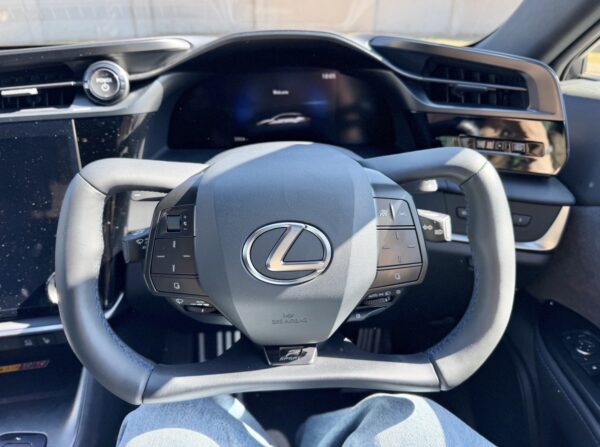
But the yoke isn’t perfect. When you’re squeezing into a tight parking spot, your natural instinct is to grab the top of a conventional steering wheel and work from there. With the yoke, you have to adjust your technique. It’s not difficult, but it does require some recalibration.
Overall, it’s a love-or-hate design. My husband was not a fan but for me, after a week, I could live with it.
7. LONG TERM VIEW
As per my Lexus RZ 550e SE Living Electric post, the same applies to the 550e F Sport.
Load Shedding Readiness: The F Sport does not come with Vehicle-to-Load (V2L) features, which means it cannot power external appliances or your home if load shedding ever returns or you have a power outage and urgently need to use it.
Maintenance: Lexus SA says service intervals are every 12 months or 15 000kms. It comes with a full maintenance plan that covers 7 years or 105 000km. The vehicle warranty is 7 years or 105 000km. And its EV battery warranty is 8 years or 160 000kms.
8. RECHARGED VERDICT
At R1.938 million, the RZ 550e F Sport is a quite the investment. But Lexus has never positioned itself as a mass-market brand, and the F Sport is very much a niche luxury product.
But even allowing for that, it’s difficult to ignore how much you’re spending. If you’re looking for a premium Japanese EV and have this kind of budget, the RZ certainly offers something distinctive.
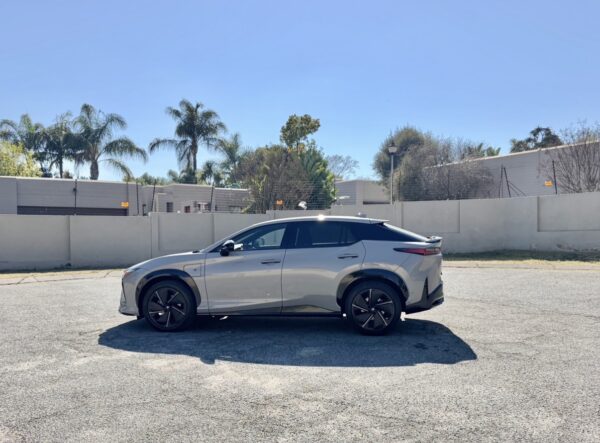
But if you’re looking for a trusted Japanese brand and an electric SUV without all the bells, whistles and avant-garde design, I say look at the Toyota bZ4X instead. It’s a much more traditional approach to electric motoring, and for many buyers, it may be more appealing.
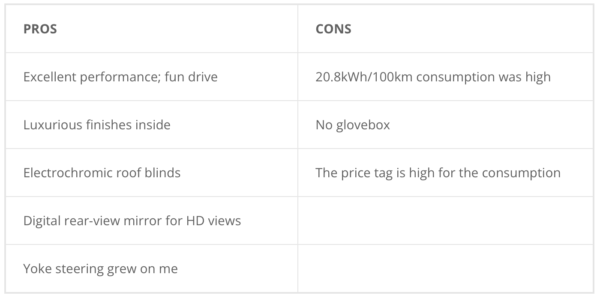
Buy it if… You want a luxury Japanese EV with serious performance, premium finishes and something genuinely different from the norm.
Skip it if… You want maximum efficiency, conventional controls or simply can’t get your head around the idea of a yoke.


Recharged is an independent site that focuses on technology, electric vehicles, and the digital life by Nafisa Akabor. Drawing from her 19-year tech journalism career, expect news, reviews, how-tos, comparisons, and practical uses of tech that are easy to digest. Nafisa is a traveller at heart, having been to 46 countries and counting. Find her edutainment videos covering tech, EVs and travel on TikTok.