
Lexus launched its first electric car in South Africa in February, at a media event in Cape Town, which Recharged was in attendance. Look out for my article soon in Brainstorm magazine.
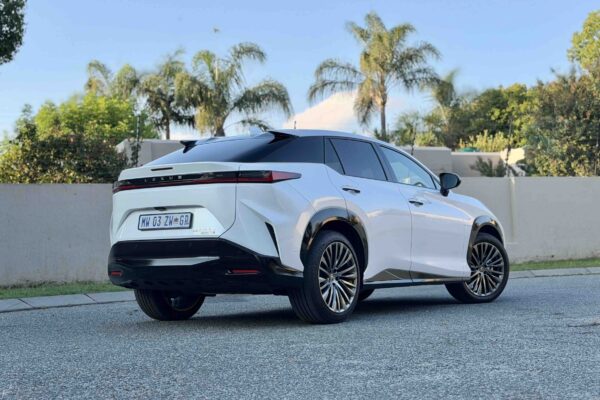
I spent a week testing the Lexus RZ 500e SE variant this April. It is the first of many new energy vehicles (NEVs) I have booked for testing back to back from now till June. They are made up of electric vehicles (EVs) and plug-in hybrids (PHEVs).
Due to the current cost of fuel, as of April 2026, and the amount of DMs asking for advice after posting a poll on Instagram, I started this new web series called Living Electric.
It will cover the practical, real-world usage of living with an EV/PHEV to help you understand the costs involved, charging situation, tech difficulties/ease, accessing the driving data, etc. If you want information about the car that appears on a brochure, please visit other websites in SA that focus on that.
The information shared here will be presented under clear sub-headings that you can easily jump to, based on your interest. The aim is to help with future purchasing decisions, if you want to make the NEV switch.
Lexus RZ 500e at a glance
- 280kW of power; 537.2Nm of torque
- Battery: 74.6kWh battery
- Claimed range: 450km
- 0-100km/h in 4.6 seconds
- Claimed consumption: 16.57khW/100km
- Price: R1.82 million
1. Who should buy this car?
Aimed at those in their late-30s or 40s professional/couple or family of four with younger kids that wants the latest tech without the learning curve. You’re established in your career, and want a car that’s more quiet luxury rather than a loud announcement that you’re doing well financially.
Whether it’s wanting a quiet cabin with high-end materials to escape the noise of a workday or parents who need a reliable, safe SUV for the school run and extracurriculars, the Lexus RZ ticks those boxes.
2. Range Reality
So this may be confusing but let me explain. When I received the car, it was charged fully and driven to me. The ticker next to the battery showed 420km of range when I received, which I drove it till there was 43km left before charging it.
Now, to anyone, 420km-43km is 377km. But the reality when I checked the odometer readings is that I did not drive 377km, but rather 215km, which is my real world usage. One of the biggest resource hogs in the car was the air-conditioner; you can easily go from 425km of range when switched off to 391km when switched on.
This is something anyone can misinterpret if they are new to EVs. The reason for this, is the Lexus RZ is a big and heavy vehicle, so it needs and uses more energy to go from A to B than say a Dolphin Surf. My consumption figures were 21.9kWh/100km, which is higher than the claimed 18.2kWh/100km for the SE variant.

This is something to factor if you want to take the Lexus on a cross-country road-trip, so charging stops should be planned accordingly.
You can always use a high regenerative-braking option to get the most back while you’re still on the road. Lexus has executed this beautifully, with two paddle shifts on the steering wheel that have a + and – symbol.
The + decreases the regeneration level while the – increases it; it goes up to 4 levels with the fourth being pretty aggressive. I couldn’t drive it on level 4, so I didn’t use it to the max. But always appreciate the varying options on any EV and more so when it’s not hidden in a digital menu that’s difficult to find or toggle.
3. Home vs. Public charging
The Lexus RZ 500e SE supports 22kW on-board charging and speeds closest to this can be achieved on three-phase power on an AC charger. Its maximum DC charging speeds are 150kW.
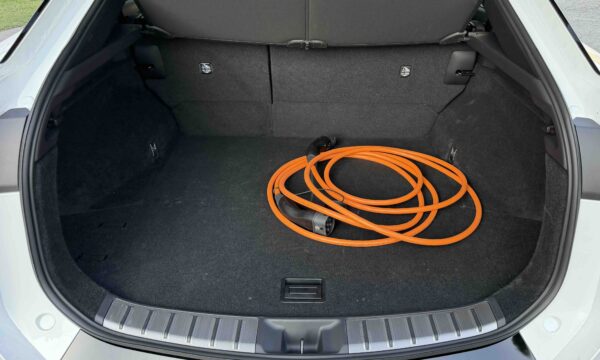
The cables to use public AC chargers are supplied in the vehicle and stored beneath the boot, however, when purchasing the vehicle, it does not come with a home wallbox charger, which is optional. Rather disappointing for a car that costs R1.82 million.
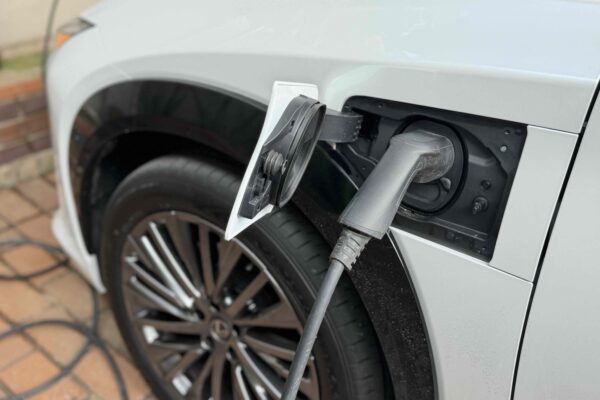
I took the car to charge at Mall of Africa and this what that looked like:
- 14-92% charge in 1hr02mins
- 66.05kWh charged at a cost of R543.94
- Works out to roughly R8.24 per kWh
- Cost per 100km: R149.43
- Location: Mall of Africa – Rubicon charger
Public Charging: I charged the Lexus RZ at one of the country’s most expensive chargers, the 200kW solar charger at Mall of Africa, owned by Audi, operated by Rubicon so their rates will kick in, and not Grid Cars.
I charged it from 14-92%, which took about an hour and cost R543.94. The only reason it cut at 92% was that my credits were running out. Otherwise I would have charged it to 100%.
Paying over R8.24 per kWh is crazy. Rubicon lists their rates as R7 per kWh for Rubicon customers; R7.35 for GridCars customers on the DC chargers; and R5.88 per kWh on AC chargers, but they acknowledge that customers using a GridCars charging card will pay up to R8.24 per kWh.
That said, it is important to note that when it comes to public chargers you pay by speed. This is why DC charging rates are different to AC charging rates. I used the AC cables in the boot at Hyde Park shopping centre briefly since the mall does not have DC chargers.
Home Charging: According to my latest Eskom bill, and for context, I pay Eskom directly and not municipality rates, I get charged R2.69 per kWh. This is based on my current usage and once you go above a certain threshold, it will cost more. My usage is for less than 600kWh, I think the rate goes up after that.
Based on those nett rates and not the other admin and network charges on my bill, the same 66.05kWh would have cost me R177.67 at home instead of using a public charger.
This is also why it’s so important to have a home wallbox charger set up at home if you are able to. I know it’s challenging when you rent or live in a complex and you’re not allowed to install chargers. My tip here for those who live in a complex is so see which EV brand has a dealership near you that provides free charging (BMW/Mini is great with this but there are others).
Petrol Equivalent: Compared to a 60L equivalent vehicle, using the rates on the AA website of R23.36 per litre for 95 Unleaded, it would cost R1401.60 to fill a tank. Hypothetically, the 74.6kWh battery would then cost R201 at home on Eskom rates; and R614.70 at Mall of Africa using a GridCars issued charge card on the Rubicon charger.
Please remember that this is purely based on me visiting Mall of Africa for this charge. The rates will differ if I went to a GridCars charger using my GridCars issued charge card. I will change it up in my future reviews but this is also based on proximity.
While I’m speaking about costs, as a paying Naked customer, I checked my app to get an insurance quote for a the Lexus RZ 500e SE and it will come to around R1982 a month, based on an excess of R7500. Bear in mind other insurances are slightly more, and this is not sponsored by them. I moved for better rates.
4. Living with the Tech
I like that there are plenty of USB-C ports, at least three in the front, with two dedicated for fast charging and one for your infotainment system link up, plus there’s two in the back for the passengers, with seat warming controls and access to the back air vents.
There’s also wireless charging if you really need it, I personally think it’s too slow (cable is king) and overheats your phone so I rarely use it on a car. There are 12V power sockets in the vehicle, too. It is well-equipped tech-wise, but there is no glove box. That said there are slots for storage in the front in the centre console below the dashboard.

The Smartphone Test: I linked my iPhone for wireless Apple CarPlay and it worked seamlessly with no issues. However, when I tired to pair a Samsung Z Fold 7, it took a few tries but it must be noted that Lexus does not support wireless Android Auto and I needed to use a cable for it. So Android was not seamless. But once both were connected, it felt like I was right at home using Google Maps from my smartphone, and accessing my own playlists and podcasts.
Physical vs. Digital: A common annoyance in newer cars is when the climate controls are only accessible through a touch interface. I’m happy to say that Lexus kept the temperature dials physical, and in terms of adjusting the fan speed, heated and ventilated seats and steering wheel, they all have dedicated touch buttons below the infotainment screen. So with one touch access you can make the cabin comfortable and weather appropriate, while still looking at your Google Maps.
5. Accessing driving data
One of the most important things when driving an EV is access to your driving data. And EVs are really all about the software, so it needs to be presented in a visually appealing way. I love seeing real time consumption as I’m driving; and just seeing how power is distributed on different modes or when regenerative braking kicks in and you can see it being recharged.
Lexus falls a bit short on this front. The infotainment system is basic. I think they could have done more visually. It does not offer a great interface for tracking your driver data. If you don’t tap on “update” after each drive, you won’t actually see your data.
The last time someone updated it was in February and when I used the car in April and tapped on it, it only showed my data just after that drive. I realised this too late unfortunately. So it’s not smart enough to pull historic data and update it.

This was a bit frustrating for me considering I downloaded the Lexus app but it wouldn’t let me link the test car to it. Now, I understand it’s likely reserved for actual Lexus owners but then, give me my driving data on your interface.
Even under trip history, it didn’t really show my previous drives. I could only see my current consumption levels and previous drive ones. There was no detailed data that I became accustomed to on the Mini during my long-term testing.
6. City driving vs. open road
City Driving: The vehicle feels powerful for its size; it may be large but it can move, which made taking off at the traffic lights fun. Getting around in an urban area or doing school drops would mean that you’re better off using the higher level regenerative braking because it would be more of a stop start situation. However, it is a large vehicle, so parking may be a bit tricky in certain places.
Open Road: The RZ is a lot more enjoyable to drive on the highways. The overtaking power when you’re at 120km/h is instant yet so quiet. Another great reason for this is that the cabin is so well-insulated. It makes you enjoy the silence almost, or not hearing the wind (well in Cape Town at least, ha).
7. Long-term view
Load Shedding Readiness: The Lexus RZ does not come with Vehicle-to-Load (V2L) features, which means it cannot power external appliances or your home if load shedding ever returns or you have a power outage and urgently need to use it.
Maintenance: Lexus SA says service intervals are every 12 months or 15 000kms. It comes with a full maintenance plan that covers 7 years or 105 000km. The vehicle warranty is 7 years or 105 000km. And its EV battery warranty is 8 years or 160 000kms.
8. Recharged Verdict
| Pros | Cons |
| Polished ride for car this size | Historic driving data not readily available |
| Silent, insulated cabin on the highways | Heavy on consumption |
| Paddle shifters offer easy access for regenerative braking | No free wallbox charger for home |
Buy it if… brand experience, quiet luxury and a smooth drive matter more to you than outright specs.
Skip it if… you’re focused on efficiency, detailed driving data and value against newer EV rivals matter more.


Recharged is an independent site that focuses on technology, electric vehicles, and the digital life by Nafisa Akabor. Drawing from her 19-year tech journalism career, expect news, reviews, how-tos, comparisons, and practical uses of tech that are easy to digest. Nafisa is a traveller at heart, having been to 46 countries and counting. Find her edutainment videos covering tech, EVs and travel on TikTok.