
My Mini Cooper SE six-month long term test came to an end in the middle of May 2025. I received the car in the mid-November and have been driving it around, since.

I posted updates on Recharged with a piece each for Forbes Africa and Brainstorm, and another wrap up piece with what I learnt in the July issue of Brainstorm including 5 ups and downs of owning an EV. You can also find updates on my social media accounts under my highlights tab on TikTok and Instagram.
I’ve always said you can only truly understand an EV if you drive it long term, which is why spending a day or half in one or attending a launch isn’t going to tell you much.
For South Africans who want to truly understand and get context about EVs before taking the plunge, manufacturers who sell EVs need to supply media with long-term units where possible to share these insights. This article will share what I’ve learned while I try to avoid duplicating content.
6 month Raw Data: Driving stats
If you don’t know, I work from home and don’t have a daily commute, which is why EV long-term tests makes sense for my lifestyle because it suits it. I don’t drive across the country or do long-distance driving.
The Mini app (reviewed here) is excellent and invaluable to any driver. It let me extract my data over the six month period in Excel format and this what the raw but useful driving data looks like:

You can tell immediately from the data, that my driving got better, as in more efficient, with time, considering month one consumption figures was at 18.2kWh/100km vs in April at 14.4kWh/100km. It’s also telling how by March I didn’t drive a lot during Ramadan for obvious reasons, and you can tell when I did a road trip in April to Charge in Wolmaransstad.
I believe the longer I drove the car, the better I understood it, which helped me become more efficient. In the beginning I didn’t always remember to switch to Efficient/Green mode and sometimes only remembered much later. I was driving it like my regular Mini (I own a petrol Mini) in the beginning.
The day before the car went back, there was another minor software update that let you start the car in Efficient mode; talk about timing! I wish I had it while I drove the car. I covered 3437km in six months.
Charging insights
Again, this is data I got from the Mini app about my charging history over six months. As I was supplied with a charge card, I charged everywhere that was convenient to me. If I was running an errand and there was charger available, I would double up and also carry my laptop and work at coffee shops.

You can immediately see I only charged the car once in March as I was abroad for nearly a week but relied on the charge from February and then just needed a charge once in March. As mentioned, it was Ramadan and I didn’t leave home unnecessarily/cut down my events.
Another interesting thing to note is the time spent charging. We all know that charging from 10-80% is the quickest on most cars, i.e. it takes roughly ±30 minutes. This is recommended to keep that battery in optimal condition. It’s usually the last 80-100% that takes the longest, which can be a huge waste of time.

I definitely hung around longer at malls or coffee shops while working than I should have, which added to the time, but this was so I could kill two birds anyway, and was productive somehow. But also crucially why it makes sense to have your own home charger so you are not wasting time at malls.
This graph below shows the DC charging curve on two separate occasions so you can clearly see how long it takes between battery percentages, starting at different times.

On the image from the left, it went from 42-80% in 20 minutes and then an hour and four minutes for the remainder. Similarly, on the right, it went from 15-80% in 32 minutes, and the last 20% took one hour and four minutes, which appears to be standard on a DC charger.
When I first saw the specifications for the Mini Cooper SE, I thought it was a pity that the maximum DC charging speed was a 95kW speed but in hindsight, it wasn’t bad enough that I noticed it an impact. The main thing is the 10/20-80% speed, which, if you are in a hurry, can only charge to that point, which is recommended.
Let’s talk Cost
My total charge was 650kWh in six months. I have a home EV wallbox charger from EV Charge. You can read my article from June 2022 when I wrote about the process of buying one.
Having a home wallbox charger allowed me to leverage Eskom rates, versus what using a public charger would cost. Mini South Africa supplied a charge card for the six month test period, which works on the GridCars network.

Here’s what my usage looks like for different scenarios:

The different scenarios include living in a house where I have home wallbox charger, vs. say someone who is renting or lives in apartment block or only has street parking and cannot install a charger. If that’s not the case, then a 3-pin plug cable cannot run from the nearest plug point to where the vehicle is parked.
For anyone who has a wallbox charger or access to one, the 650kWh usage would have come to R1592.50 over those 6 months at home. Very NB here is that Eskom charges per kWh, and public EV chargers are priced by speed, which is why an AC Charger costs R5.88 per kWh vs. a DC charger at R7.35 per kWh.
All Mini drivers get one year of free charging at Mini or BMW dealerships in South Africa. Once that year is up, the rate you pay, as listed on the table above, is R7.06 per kWh. This was the flat rate printed on the charger at Mini Midrand, as of May 2025.
So if you don’t have a home charger, you will have to rely on public or dealership chargers. Public ones being at office parks or shopping centres.
Another thing to factor is the possibility of the charging bays being occupied after you get to the charging point, or for it to be offline, broken or not accessible because of load shedding. It is worth taking a note of nearby dealership chargers and to see if they have back-up power. I understand all BMW/Mini dealership chargers have back-up power.
Let’s talk Range
As mentioned, my total KMs over the 6 month period was 3437kms, which means I averaged 573km a month. When you charge the battery of an EV, there are some little differences in the range, based on your driving patterns prior to charging.

So, in one instance I had 270km of range and another, 410km after a full charge, after putting it in Efficient Mode. This might seem confusing to many, but I only contextualised this after spending this much time in the vehicle. It uses an average of your previous tally from a single charge.
The instance where I had 270km after a full charge involved a lot of start and stops; i.e., short distances back and forth in one afternoon, like 6 trips between two meetings including giving someone a lift. This had a negative impact and used up more range than it typically would for longer trips.
And the case where I had 410km of range was on my trip to Charge at Wolmaransstad. I drove the most efficient I have ever driven, and netted 20km of range for a 144km stretch. In fact, my consumption figures were lower than what Mini claims you can get from the 2024 Mini Cooper SE, which is between 14.7-14.1kWh/100km.
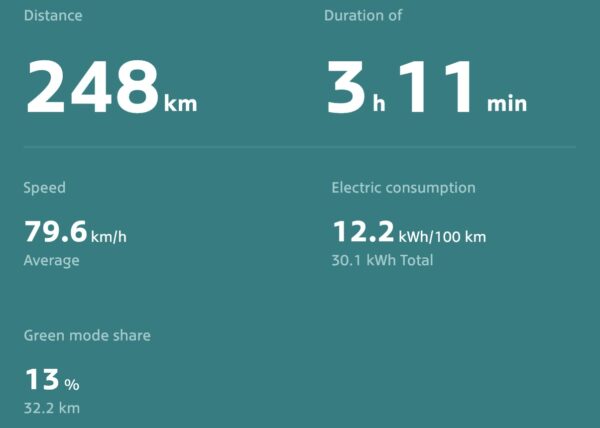
The the six months I had driven the Mini, I didn’t quite experience range anxiety because I kept the car topped up, and I used the 20% battery level as an indicator to charge the vehicle.
As long as you have flat roads, you can easily regenerate and gain range. I once drove from Wits back home and gained almost 40km of range, but mostly because it was late at night and I didn’t have to contend with busy roads.
General driving experience
My experience with the Mini was very different to my long-term drive with the Volvo EX30. I love it when the tech in a car works seamlessly.
I didn’t have issues pairing the car to the app, you simply use the VIN number to link it, and log into a Mini account if you have one by scanning a QR Code. It paired on the first try. I could then access whatever data I wanted to, use the GPS freely, without leaving a trace of me using the car or where I went, when I logged out.
I also linked the car key by having both keys present, to my Apple Watch and iPhone using the ultra-wide band support on my devices. This allowed me to use my watch exclusively as my key to the extent that very early on, I ditched the physical keys.
I realised carrying it was redundant when it opened and locked for me without touching the physical keys. This was useful when carrying groceries. The one downside to this early on was going to the car wash and forgetting to remove the key from the car as it locked when I walked away. I subsequently handed them the key before walking away.
Another minor thing I realised I could adjust was the angle of the head-up display. I thought based on my height it would be awkward to see properly but eventually saw in the settings that it could be adjusted. Other nifty things like the headlights and taillights are also customisable, in typical Mini fashion.
The app was invaluable to my driving experience, especially remote monitoring of the charge, and several instances I could pick up when the car stopped charging, this was always the case of the charger being faulty.
Paid features
Driving a Mini for a long as I did meant eventually the services that came free for three months would run out. When that happened, I had to go back to “default” settings from what I was accustomed to.
However, Mini South Africa reinstated the services. The Mini Connected Package costs R159 per month and included things like Driving Assistant Plus, Mini Connected Base, Mini Connected Package and Mini Online.
Driving Assistant Plus helps with things like maintaining speed, staying in the lane, keeping a safe following distance (these features were nifty on the highway), and it can break and accelerate automatically. It can also help you manoeuvre in tricky situations but most of the time I found it easier to reverse out of my garage than let the car do it.
Mini Connected Base has access to cloud based navigation, Digital Key Plus, Intelligent Emergency Call, Remote software upgrades, remote services via the app, remote 3D view and tele services.
@nafisaakabor Who needs a physical key?!Digital Key Plus on the Mini Cooper SE. #electriccar ♬ Digital – Elias Malta
The Mini Connected Package includes access to apps and games; a Navigation upgrade with 3D buildings and more details with directions and up-to-date parking and charging costs where supported; a doors and windows upgrade to automatically open the window when you approach a barrier and your usual car park spot using geotargeting; and using Spike, the dog, a personal assistant with routines using geo-targeting.
Like any paid service, there are ones that you will find useful or use most vs some you won’t even consider using. If I’m being honest, I found the Digital Key Plus feature invaluable, amongst other features like driving assistant plus and the personal assistant useful enough to warrant the price.
I got so used to asking Spike to do things for me, like turn up or down the climate, turn on the heated steerings wheel, or switch to a radio station; basically accessing car settings instead of sifting deep into menu links, which can be cumbersome on modern cars, especially when you don’t know where to find it.
Final Thoughts
Six months with the Mini Cooper SE has reaffirmed what I believe: you won’t truly understand an EV until you live with one. Half day trips, flashy launches, or showroom specs don’t capture the nuance of real-world electric driving, especially not in a South Africa.
From charging quirks and cost breakdowns to software perks and driving behaviour shifts, it’s everyday use that determines whether an EV fits your lifestyle. I hope my six-month journey provides insight to whoever may be reading, to help on your future EV journey.
For me, the experience was not just smooth, but transformative. I became more efficient, more aware, and surprisingly reliant on features I didn’t expect to miss: like a smartwatch key and voice assistant.
But more importantly, it proved that electric driving is viable for those with the right setup, while also highlighting just how much work still needs to be done to make EV ownership more accessible and seamless across the country.
Mini Cooper SE base model cost: R802 000.
Kitted with extras: R924 500.
Monthly average cost to run: R265.42 (home owner)
Monthly average cost publicly: R637-R796 (AC and DC)


Recharged is an independent site that focuses on technology, electric vehicles, and the digital life by Nafisa Akabor. Drawing from her 19-year tech journalism career, expect news, reviews, how-tos, comparisons, and practical uses of tech that are easy to digest. Nafisa is a traveller at heart, having been to 46 countries and counting. Find her edutainment videos covering tech, EVs and travel on TikTok.