
Longer finance terms and balloon payments can leave motorists owing more than their insurance will pay if their car is stolen or written off.
South Africans who finance their cars could be left owing money on vehicles they no longer have if their car is stolen or written off, even when they hold comprehensive insurance.
That’s according to Sumarie Greybe, co-founder of digital insurance platform Naked, who says the issue arises because comprehensive insurance covers the insured value of the car (retail, market, agreed or trade-in, depending on the policy) and not the outstanding balance on the finance agreement.
CAR GONE, DEBT REMAINS
If the car loses value faster than the loan balance falls, the insurance payout may not be enough to clear the debt. Credit shortfall cover, sometimes called gap or top-up cover, can bridge this gap following a valid claim.
“Imagine making monthly repayments on a car you no longer have. As strange as it sounds, it is easy to assume that comprehensive insurance means you are fully protected, but that is not always the case,” says Greybe. “If the settlement amount on your finance agreement is higher than the insured value of your car, you remain responsible for the difference.”
The issue is particularly relevant as affordability pressures reshape vehicle-finance choices. TransUnion’s Q1 2026 Mobility Insights analysis notes that finance terms now extend beyond six years for many buyers. It says the shift towards longer terms and balloon-payment structures reflects a growing focus on monthly affordability and cash-flow flexibility, while increasing consumers’ exposure to owing more than their vehicles are worth.
For example, if your finance settlement amount is R520 000 but your car’s insured retail value is R430 000, you could face a R90 000 credit shortfall.
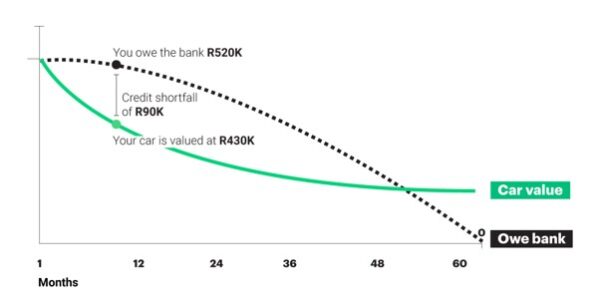
The gap arises because the car’s value and the outstanding loan balance do not necessarily fall at the same pace. Depreciation reduces the car’s value as it gets older and does more kilometres.
At the same time, a larger portion of your monthly instalment goes towards paying off interest early in the loan term, so the outstanding balance does not fall as quickly as you might expect. This can create a period when your car’s insured value is significantly lower than the outstanding amount on your loan.
“Customers often tell us they hadn’t considered that they might still owe the bank money after their insurer pays out,” says Damian Colman, Head of Customer Success at Naked. “To see where you stand, ask your bank what it would cost to settle your loan today and check with your insurance provider what your policy would pay if your car were stolen or written off.”
“The risk of a credit shortfall is generally greatest during the first few years of a finance agreement, especially if you opt for a balloon payment as many South Africans do ,” says Colman.
“If your car is stolen or written off during this period, you could face a difficult choice: buy a cheaper replacement while repaying the shortfall on the original loan, or take on higher monthly repayments to replace the car with one of similar value while also settling the outstanding debt.”
FACTORS THAT CAN INCREASE A CREDIT SHORTFALL
The circumstances that could increase the potential gap between a car’s insured value and the outstanding loan, include:
- You have a balloon payment. The lump sum due at the end of the repayment period remains part of your outstanding debt.
- You made a small or no deposit. This means you financed more of the car’s purchase price.
- You chose a long repayment term. The longer the loan term, the longer the finance balance may remain above the vehicle’s value.
- You bought a new car. Depreciation tends to be steepest during the early years of ownership. A new car may lose around 15% to 20% of its value during its first year and 30% by year two.*
- You have a high interest rate. A greater portion of your instalment goes towards interest rather than reducing the amount borrowed.
- You are early in the loan term. You may not yet have repaid much of the original debt.
“The good news is that shortfall cover is usually available as a small monthly add-on to your car insurance premium, far cheaper than paying off a shortfall on a loan yourself,” says Greybe. “On Naked’s app, you can see with a few clicks how much shortfall cover would add to your premium when you get a quote.”

A cash buyer does not need credit shortfall cover. A financed customer may also no longer need it once the finance settlement amount falls below the likely insurance payout. Others may choose to carry the risk themselves if they can comfortably settle the difference.
“Review your financial position as you repay the loan. The aim is to protect yourself while a shortfall exists, and to reconsider the cover when it no longer serves a purpose,” says Greybe.


Recharged is an independent site that focuses on technology, electric vehicles, and the digital life by Nafisa Akabor. Drawing from her 19-year tech journalism career, expect news, reviews, how-tos, comparisons, and practical uses of tech that are easy to digest. Nafisa is a traveller at heart, having been to 46 countries and counting. Find her edutainment videos covering tech, EVs and travel on TikTok.