
Toyota, the world’s largest carmaker, stands out from its competitors by prioritising hybrids over battery electric vehicles. It has what it calls a “multipathway” approach to decarbonisation, which involves using batteries with hybrids, as well as hydrogen and alternative fuels.
Rivals in Europe and China have accelerated their EV rollouts, but Toyota has taken a more cautious approach, which has been criticised by analysts, investors and environmentalists for failing to fully commit to electric.
In South Africa, EV sales have been held back because there are too few public charging stations, and the cars are expensive. In 2025, 1 018 EV cars were sold, compared to 2 808 plug-in hybrid electric vehicles.
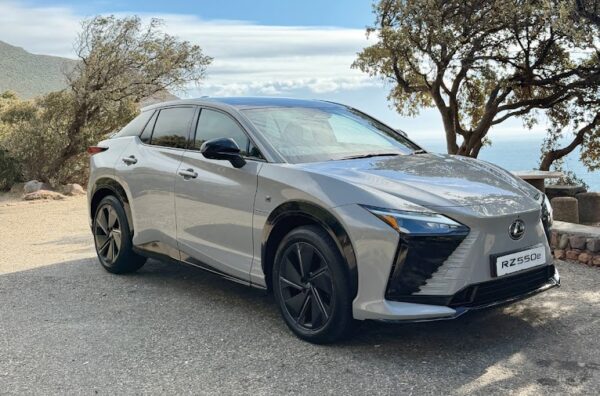
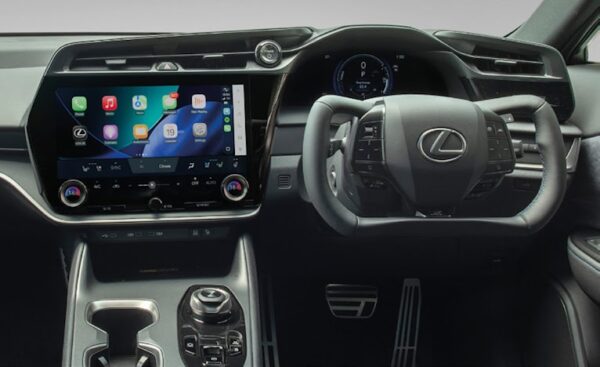
Toyota’s luxury vehicle division Lexus launched its RZ in February 2026, and is the brand’s first fully electric model in South Africa. Despite being late to the party, the RZ didn’t arrive empty-handed. The performance variants on the car introduce one of the brand’s most ambitious pieces of technology: a yoke-style steering wheel paired with a full steer-by-wire system, replacing the traditional mechanical link between wheel and front axle with electronic inputs.
Lexus calls this “One Motion Grip”, and it replaces the traditional mechanical steering column with electronic signals that control the wheels. This means the steering ratio adjusts itself depending on the speed you’re driving. The setup requires only about 200 degrees of rotation from lock-to-lock, meaning drivers don’t need to perform the usual handover- hand turning motion.
This comes with the RZ F Sport model, and delivers faster steering response and a more direct driving feel. The yoke design also means you can see the instrumentation better because it’s not blocked by a conventional steering wheel. It’s a bold statement that shows Lexus isn’t just entering the EV space, but is rethinking the driving experience, setting it apart from its competitors, which already have a headstart in electrification.
At the Cape Town launch event, Lexus said it plans to be a fully electric brand by 2030, with the RZ marking the beginning of that pivot. The two models on offer are the 280kW RZ 500e EX, for around R1.6mn, and the 300kW 550e F Sport, at about R1.94mn.
The base model has a 74.6kWh battery, which should be enough for R500km of range; the F Sport has a slightly larger battery at 76.9kWh, which provides up to 450km. With the RZ, Lexus is targeting the same customers as the BMW iX (R.1.65mn) and Mercedes-Benz EQB (R1.3bn), which both have similar outputs and range.
The RZ carries the brand’s signature design language from the last decade, with sharp creases and angular surfaces.
Its signature “spindle” hourglass grille has evolved into a sealed spindle body, where sculpted bodywork replaces the traditional grille to improve airflow and enhance efficiency.
The cabin is modern and spacious, with plenty of USB-C ports, a large infotainment display, and an ergonomically laid out dashboard where everything is within reach. Lexus has always paid great attention to detail, and these models have soft-touch materials and a minimalist design, giving the interior an uncluttered feel that suits a luxury EV.
The base model delivers a smooth and refined experience as it glides through the city, with traffic noise silenced in the insulated cabin. There was also seamless pairing with the Apple CarPlay, which meant no fumbling.
The EX lacks a head-up display, 14-inch HD screen, and Mark Levinson audio, with 13 speakers found on the rest of the line-up, but has 18-inch tyres, heated front seats and Lexus Premium Audio as standard.
I was more excited to get into the F Sport to try the steer-by-wire system. After feedback from journalists who drove it earlier in the day, I expected a steep learning curve, but all of that went out the window once I got behind the wheel.
The steering felt natural and because the turns were quick or stable depending on my speed, I didn’t find myself looking for missing parts of the steering wheel. I also welcomed the unobstructed view of the instrument cluster.
Other features worth noting on the F Sport include 20-inch tyres, a digital rearview mirror, dimmable panoramic roof, wireless charging, and a manual transmission-like option with paddle shift controls. The dimmable sunroof is underrated; it prevents you from blasting the aircon and reducing your range on hot days, something that left me with range anxiety on the Audi e-tron GT.
Understandably, EV launch drives are short when you factor in city traffic and the time it takes to stop for a charge, but this is a car that left me wanting more time behind the wheel.
At a starting price of R1.65m, Lexus disappointingly does not include a wallbox charger, unlike its rivals. A home wallbox charger is essential for EV ownership and should be standard, not an optional extra as it eliminates the need for reliance on public chargers.
The arrival of the RZ shows that Lexus is finally serious about playing in the electric space. In South Africa, where charging stations, pricing and consumer hesitation play a role in adoption, the brand’s careful approach may prove pragmatic with its initial allocation of 50 cars. The RZ may not lead the EV race, but shows that Lexus is ready to run it.
LEXUS RZ 500E SPECS
Output: 280kW and 537Nm of torque
Battery: 74.6kWh battery
Range: 500km (WLTP figures)
Consumption: 16.57kWh/100km (claimed)
Top Speed: 180km/h
Acceleration: 0-100km/h in 4.6 seconds
Charger: 22kW onboard charger
DC Fast Charging: 10-80% in ~30 minutes
Price: R1 649 400
Originally published in Brainstorm.


Recharged is an independent site that focuses on technology, electric vehicles, and the digital life by Nafisa Akabor. Drawing from her 19-year tech journalism career, expect news, reviews, how-tos, comparisons, and practical uses of tech that are easy to digest. Nafisa is a traveller at heart, having been to 46 countries and counting. Find her edutainment videos covering tech, EVs and travel on TikTok.