

You can tell a car is in a league of its own when a week after driving it, the email waiting in your inbox is a speeding fine. That was my experience with the sleek “flare red” MG Cyberster.
After years of testing electric vehicles, this was a first, and a reminder that 0–100km/h in 3.2 seconds is not just a number on the spec sheet.
But that’s when it hit me: when a two-seater electric roadster this striking triggers an infringement notice before I’ve even written my review, it’s not meant to be practical – it’s meant to be quick. MG, a brand born in the UK, but under Chinese ownership since 2007, reintroduced itself to the South African market early in 2025.
Its flagship Cyberster has a dual-motor AWD configuration with a total output of 375kW and 725Nm of torque, and a top speed of 208km/h. Its 77kWh battery yields 443km of range.
It has a price tag of R1.39mn and comes with home charging cables, including a vehicle-to-load feature that owners probably won’t ever use.
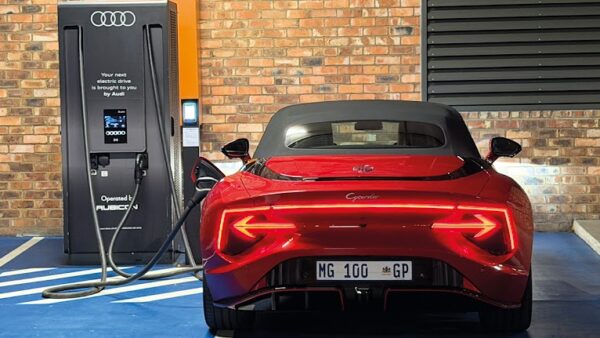
The Cyberster is a two-door convertible with a low profile and arrow-shaped taillights, characterised by electric scissor doors, a rare sight in a South African market obsessed with SUVs.
Opening the doors is theatrical, and there are many ways to do it: buttons on the door from outside and inside, another two in the centre console, and on the key itself. The roof also has its own dedicated control, and yes, the first time you press it, you will look around to see if anyone is watching. Getting in and out of the car made me self-conscious while running errands. Strangers were not shy to approach me.
For the frequent traveller, the Cyberster will test your packing discipline. The boot is 249L and it’s not even the height of my forearm. You can fit a weekend duffel on the front passenger seat, but you can forget about checked-in luggage. This is a reminder that the Cyberster is not pretending to be your primary car. MG knows this, and buyers know this.
There’s also an open net storage compartment behind the seats for small bags or things you don’t want blown away when the roof is down. The cup holders have retractable bases that flatten out to create a smooth surface when you’re not using them; a small touch, but one that speaks to how intentionally nonpractical it is.
Slip into the driver’s seat and you’re in a fully digital cockpit, with three screens in front of you that feel part gamer rig, part EV showcase. There is also Bose audio.
The screen on your left is for phone controls, audio sources and navigation, while the middle instrument cluster differentiates driver modes, like blue for Comfort or red for Super Sport; and the third is information dense with trip summaries, energy consumption, charging info and tyre pressure.
The centre console has yet another display for expanded climate control next to a gear selector with buttons for Park, Reverse, Neutral and Drive. Above that are additional touch sensitive climate and camera controls. The futuristic setup relies heavily on touch, and whether you love or hate it depends on your relationship with smudges and haptic feedback.
I love driving EVs for the instant torque. The Cyberster was responsive, but not twitchy. However, when you go above the speed limit, you hear beeping, reminiscent of the Volvo EX30, which I was clearly ignoring when I drove past the speed trap.
The simplicity of switching between two distinct driving modes is great: Comfort for a relaxing drive, or Super Sport when you want to feel the surge. There’s also Sport and Custom modes, plus four regenerative braking settings. But, honestly, I wasn’t paying attention to the range, which is over 400km after a full charge, despite it being heavy on consumption. One of my 28km stretches had a 26.1kWh/100km reading; MG lists its official consumption figure as 19.1kWh/100km.
I appreciated the screen visuals when charging, which lets you see percentage and range in real-time, plus what it will reach at 100% based on your driving style. However, I found that the supplied charge card did not work at certain chargers, like the one at Vodacom World in Midrand. The brand says it’s aware of this issue.
No EV test is complete without me picking up at least one software glitch and in this instance, it was data that was slightly off. I found the timestamps of my trip summaries to be inconsistent with my actual drive times. Nothing critical, but enough to remind you this is still early-stage EV UX refinement. In an ideal world, EVs would run Android Automotive or CarPlay Ultra for deeper, native integration with the car’s hardware.
Typically, South African EV conversations are centred around charging infrastructure, high import duties, slow adoption or lack of incentives, but the Cyberster ignores all of these talking points.
It’s an EV you buy based on emotion, not spreadsheets. It’s fun, indulgent, expressive and even slightly ridiculous in the best kind of way.
And maybe that’s what makes the speeding fine matter. Not because of the rands, but because it proves the Cyberster achieved something most EVs fail to do: it made me forget briefly that I was testing an EV.
Instead, I was just driving: roof down, torque ready.
Output: 375kW and 725Nm of torque
Battery: 77kWh
Range: 443km
Consumption: 19.1kWh/100km
Top Speed: 208km/h
Acceleration: 0-100km/h in 3.2 seconds
Charge time: 10-80% in 40 minutes (DC)
DC Charging: Max 144kW
Originally published in Brainstorm.


Recharged is an independent site that focuses on technology, electric vehicles, and the digital life by Nafisa Akabor. Drawing from her 19-year tech journalism career, expect news, reviews, how-tos, comparisons, and practical uses of tech that are easy to digest. Nafisa is a traveller at heart, having been to 46 countries and counting. Find her edutainment videos covering tech, EVs and travel on TikTok.



