
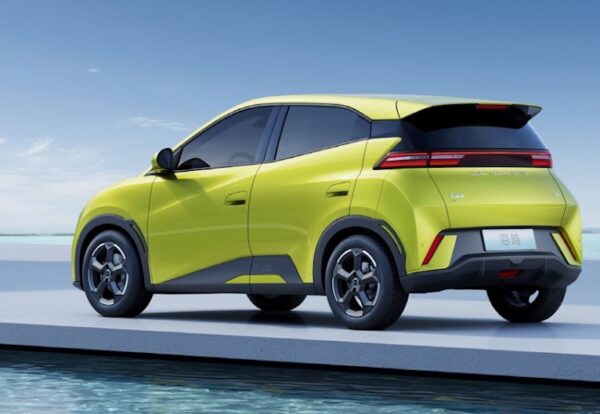
China’s leading new energy vehicle automaker BYD now offers its complete suite of ADAS software for free in all its cars.
At the heart of all modern vehicles lies intelligent software and, in particular, advanced driver assistance systems (ADAS), which are transforming vehicles into rolling software- defined computers, improving car and road safety. According to Motor- Trend magazine, a new car now has over 100 million lines of code running through its electronic control units; McKinsey estimates that a connected car generates around 25GB of data every hour.
But ADAS comes with a steep price tag. That is until China’s leading new energy vehicle automaker BYD started offering its complete suite of ADAS software for free in all its cars.
In February, it announced a facelift for 21 of its vehicles equipped with its version of ADAS called DiPilot. The system will be included in its premium vehicle, the Yangwang U8, priced at $153 750 (R2.8mn), to its cheapest, the Seagull EV/battery electric vehicle at $9 500 (R173 000).
Brands such as Audi, BMW, Lexus, Mercedes-Benz, Porsche and Volvo offer various ADAS, tech and safety features as optional extras, while Toyota, Hyundai and Kia include features such as adaptive cruise control, lane keeping, collision avoidance, driver monitoring and parking assist, among others, as standard.
I recently drove the BMW X3, with a “Driving Assistant Professional” package as an optional extra for a whopping R30 000. It includes a remote parking feature that allows you to manoeuvre the car into tight spots using a smartphone with ultra-wide band support for low-latency communication.
BYD’s DiPilot, meanwhile, has three tiers: the DiPilot 600 with a triple- LIDAR setup exclusively for its Yangwang models; the DiPilot 300 with a single LIDAR unit for its Denza and select BYD models; and the DiPilot 100, which uses a tri-camera set-up with basic features in all other BYD cars. BYD’s move not only challenges the industry’s lucrative pricing models, but also signals a broader shift in consumer expectations.
Drivers accustomed to paying extra for essentials might soon question the justification for these premiums.
A nice-to-have?
Greg Cress, automotive and e-Mobility lead for Accenture Africa, says the trend now is to label advanced L2 or L3 self-driving ADAS systems with a catchy name, such as Autopilot (Tesla), BlueCruise (Ford), or Highway Assistant (BMW), as an optional up-sell to new and existing customers.
“Broadly speaking, it’s EV startups like BYD, Lucid and Rivian that are offerings their L2 ADAS packages as standard. Ultimately, it comes down to a commercial decision: whether or not to use ADAS as a means to bring added value to the product, or to leverage it as a means to generate new services annuity revenue,” says Cress.
“Is ADAS a nice-to-have, or a critical safety feature, which, in a few years’ time, will become as ubiquitous and as necessary as having a seat belt in a vehicle?”
According to Research and Markets, the ADAS market is expected to grow from $43.03bn in 2024 to $50.13bn in 2025. The growth reflects the increased focus on vehicle safety, regulatory mandates for safety features, rising consumer awareness, integration of ADAS in premium vehicles and the growing complexity of modern vehicles.
Affordability
By 2029, it sees the development of AI-based driver monitoring systems, expansion of augmented reality in head-up displays, enhanced connectivity with advanced sensors, evolution of automated parking systems, and the integration of machine learning for improved decision-making in ADAS. Cress says many markets are likely to implement regulations and standards before L2 or L3 ADAS is permitted on public roads.
“This means that it is likely we will only see limited extended-test proof of concepts in South Africa for L3 [autonomous] full-self driving technologies before a mass take-up.”
Similarly, the growth of Chinese vehicles in South Africa and what it means for German cars cannot be ignored. Chinese cars offer a range of extras as standard, undercutting the competition.
Both Chery and GWM are in the top 10 list of most sold vehicles in South Africa, while Omoda and Jaeceoo have climbed to the 14th position in 2025, ahead of Mercedes-Benz and Jaguar Land Rover, according to Naamsa’s sales figures.
While BYD does not report sales figures to Naamsa, it is set to bring the Seagull to South Africa in 2025, under the “Dolphin Mini” badge. The entrylevel compact hatch is a top-seller in China.
One just needs to look at the short history of the smartphone industry to see the parallel that is occurring now in the automotive industry, says Cress. “Customers are driven by affordability, tech-savviness and are not necessarily brand-loyal.
“The same consumer shift is now happening in the automotive sector, but there’s a twist. Not only do the Chinese alternatives offer affordability and tech-savviness, but they have inherently better technology, especially when it comes to the underlying electric architectures, electric motors, and batteries.”
As software increasingly defines automotive excellence, the era of exorbitantly priced add-ons could be coming to an end. How will traditional automakers adapt, and what does it mean for the future of mobility?
Cress says the automative sector is entering turbulent waters, and legacy OEMs will look to the East for hardware or electric architecture partnerships, and to the West for software partnerships. “A shake-up in the global order is definitely possible. Although we won’t see a dramatic closure or imminent bankruptcy of legacy OEMs, we should definitely see a fast adaptation and new product roadmaps being released in accelerated timelines.”
This article was published in the May edition of Brainstorm magazine: https://brainstorm.itweb.co.za/content/JN1gP7OA3X2qjL6m


Recharged is an independent site that focuses on technology, electric vehicles, and the digital life by Nafisa Akabor. Drawing from her 19-year tech journalism career, expect news, reviews, how-tos, comparisons, and practical uses of tech that are easy to digest. Nafisa is a traveller at heart, having been to 46 countries and counting. Find her edutainment videos covering tech, EVs and travel on TikTok.