

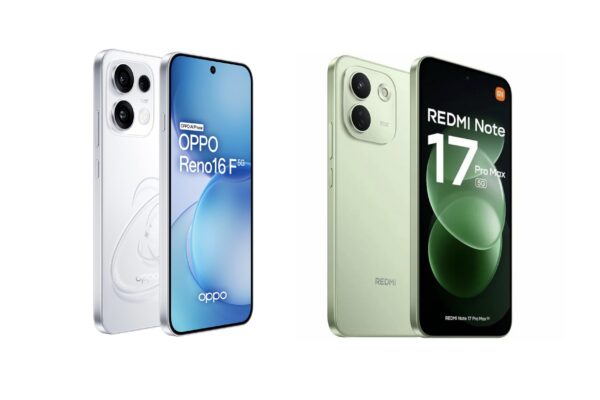
The Oppo Reno16 F 5G and Xiaomi Redmi Note 17 Pro Max both gave me reasons to reconsider my iPhone loyalty, but for very different reasons.
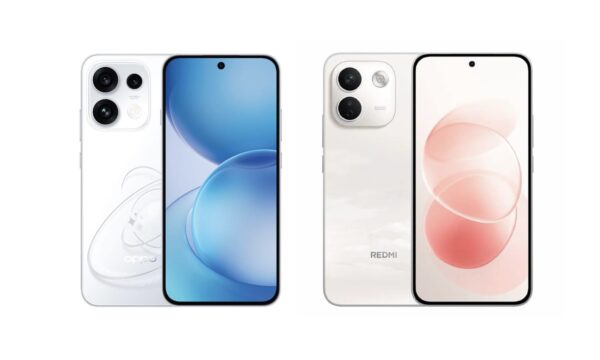
Xiaomi won me over with remarkable battery endurance, while Oppo made creating and sharing content easier. Choosing between them comes down to how you actually use your phone.
As someone who regularly listens to audiobooks while gaming, streams Formula 1, takes plenty of photographs, and occasionally needs to get some actual work done, I expect quite a lot from my smartphone.
I’ve spent time reviewing both devices, and neither left me disappointed. However, despite their similar pricing, they’re surprisingly different phones.
RENO16 F VS REDMI NOTE 17 PRO MAX: THE SPEC
Before getting into my experiences, here’s how the two smartphones compare on paper.
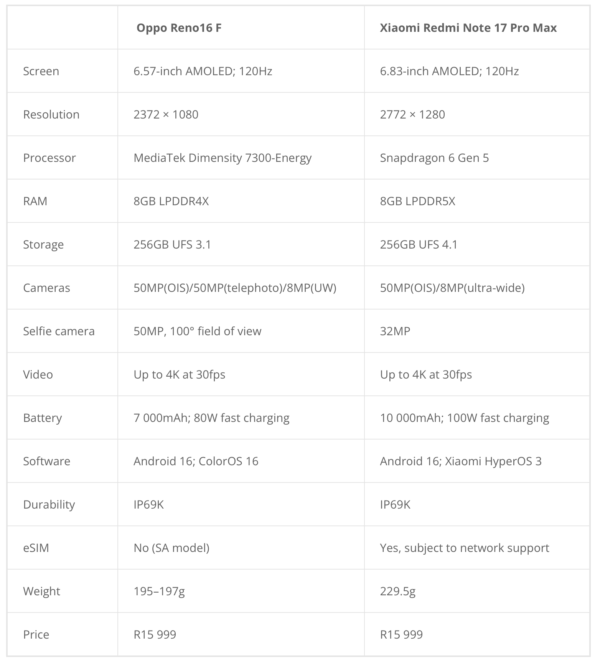
Prices reflect the reference retail figures used for these reviews and may differ between retailers, promotions, and configurations.
BATTERY LIFE: XIAOMI MAKES A VERY CONVINCING ARGUMENT
If there’s one thing guaranteed to get my attention, it’s a phone that doesn’t constantly demand a charger. The Redmi Note 17 Pro Max has an enormous 10 000mAh silicon-carbon battery, compared with the Oppo’s 7 000mAh battery.
And yes, size matters here.
During my time with the Xiaomi, I managed approximately 36 hours of mixed use. That included listening to audiobooks while playing games, watching F1 TV, and switching between applications. It wasn’t 36 hours of continuous screen time, but it was an impressive result given my habits.
Charging from 5% to 100% took 1 hour and 32 minutes in my test. Although the phone supports 100W HyperCharge, actual charging times depend on several factors, including the charger, settings, and temperature.
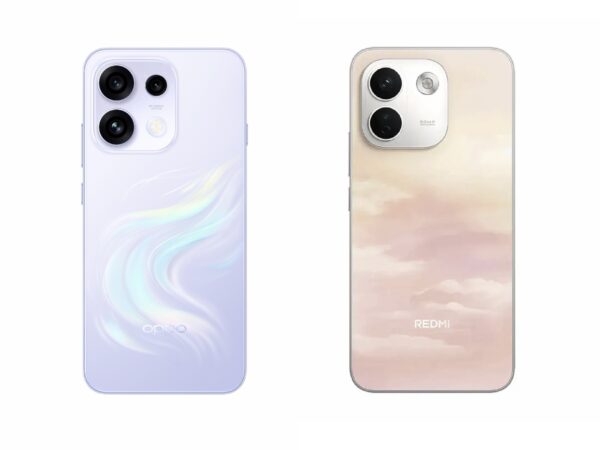
The Oppo Reno16 F was hardly a disappointment, though. Oppo claimed around two days of average battery life at its South African launch. During my testing, I charged the phone when it reached approximately 20%, roughly halfway through my second day of active use. I was also streaming, gaming, and listening to audiobooks.
Interestingly, the Oppo didn’t become noticeably hot, even while charging or juggling multiple apps. That’s more than I can say for my iPhone 14 Pro on some occasions.
I didn’t conduct identical, controlled battery tests, so my results aren’t directly comparable. Nevertheless, the Xiaomi’s larger battery and impressive endurance make it the more attractive option for anyone who prioritises time between charges.
Battery winner: Xiaomi Redmi Note 17 Pro Max.
CAMERAS: OPPO WINS ON VERSATILITY, BUT XIAOMI HOLDS ITS OWN
Here’s where things get interesting. Both smartphones have 50MP main cameras with optical image stabilisation, but Oppo adds a dedicated 50MP telephoto portrait camera with 3.5× optical zoom. That’s a big advantage if you enjoy photographing people, food, or interesting details without having to move closer.
The Oppo also features a 50MP front camera with a 100-degree field of view, compared with Xiaomi’s 32MP selfie camera. Higher megapixel counts don’t automatically produce better photographs, but Oppo offers more compositional flexibility.
What Did My Actual Photographs Look Like?
Both phones produced photographs that looked brighter than those I typically capture with my iPhone 14 Pro. The Xiaomi impressed me with crisp images, particularly when using its default camera and portrait modes. I could take a photograph without spending ages adjusting settings and generally liked the result.
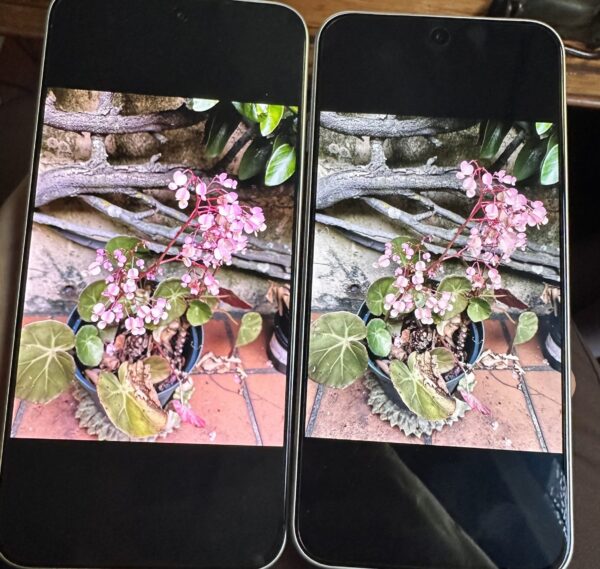
The Oppo’s photographs looked particularly vibrant, with rich colours that appealed to my preference for bright, lively images.
Camera versatility winner: Oppo Reno16 F.
DESIGN AND DISPLAY: BIG SCREEN OR COMFORTABLE HANDLING?
The Xiaomi has a larger 6.83-inch AMOLED display with a higher resolution than Oppo’s 6.57-inch offering. Both support a 120Hz refresh rate, making scrolling and general navigation feel smooth.
Xiaomi also offers higher specified display brightness, along with Corning Gorilla Glass Victus 2 protection. For watching F1, streaming videos, or gaming, the larger display is a definite attraction.
However, Oppo makes a compelling argument for something smaller. My Pop White review unit weighed approximately 197g, compared with Xiaomi’s specified 229.5g.
The Oppo was noticeably light in my hand. Its three-dimensional Pop Planet design also gives it a fun, distinctive appearance. I’m a fan of phones that don’t look like every other rectangular slab on the market.
Both devices feature IP69K water and dust resistance, although that doesn’t make them immune to damage.
I also tested Oppo’s wet-screen and glove-touch functionality using wet fingers and thin cotton gloves. Both worked perfectly. Xiaomi supports Wet Touch Technology 2.0, but I didn’t perform an equivalent test.
Display winner: Xiaomi. Design and handling winner: Oppo.
EVERYDAY PERFORMANCE: BOTH KEPT UP WITH MY MULTITASKING
A phone can have impressive specifications, but they don’t mean much if it struggles to handle everyday activities. Fortunately, neither device gave me reason to complain.
The Redmi Note 17 Pro Max handled switching between applications without noticeable lag. Listening to audiobooks while gaming was straightforward, and I never felt as though I was waiting for the phone to catch up.
The Oppo also managed my usual combination of streaming, entertainment, and multitasking comfortably.
Both use efficient 4nm processors, although Xiaomi’s LPDDR5X RAM and UFS 4.1 storage are technically faster memory and storage standards than Oppo’s LPDDR4X and UFS 3.1. That doesn’t automatically translate into a noticeable performance difference in every application, and I didn’t run comparative benchmarks. For my everyday activities, both delivered the responsive experience I wanted.
Everyday performance winner: A tie.
EDITING AND SHARING: OPPO UNDERSTANDS CONTENT CREATORS
This is an area where Oppo really appealed to me. The Reno16 F includes several creative features designed to make taking, editing, and sharing photographs more convenient.
Pop Cam adds vintage photographic effects, while AI Remix Collage and Popout 2.0 help turn ordinary images into more playful compositions. AI Portrait Glow offers lighting adjustments, and Dual-View Video 2.0 allows you to capture your reaction and the scene simultaneously.
Xiaomi isn’t short of editing features either. Its AI tools include object removal, glare reduction, image expansion, and other useful adjustments. They’re particularly appealing when you want to tidy up a photograph.
The difference is one of emphasis: Xiaomi provides plenty of practical editing tools, while Oppo puts more focus on creative presentation.
THEN THERE’S O+ CONNECT
One of my frustrations with the Xiaomi was transferring photographs to my iPhone. Android-to-Android sharing worked without problems, but moving files to iOS wasn’t nearly as convenient. Oppo’s O+ Connect app provides a wireless transfer option between compatible Oppo phones and iPhones.
Content creation and cross-platform convenience winner: Oppo Reno16 F.
VALUE FOR MONEY: WHICH PHONE GIVES YOU MORE?
At the reference price of R15 999 each, the decision becomes tough. Xiaomi offers an enormous battery, a larger and sharper display, fast charging, eSIM support, and a capable camera system. Oppo provides a lighter design, more camera options, enjoyable creative features, and a smoother cross-platform sharing experience.
South African shoppers should also compare current cash prices and contract costs, particularly when promotional bundles are involved.
RENO16 F VS REDMI NOTE 17 PRO MAX: WHICH SHOULD YOU BUY?
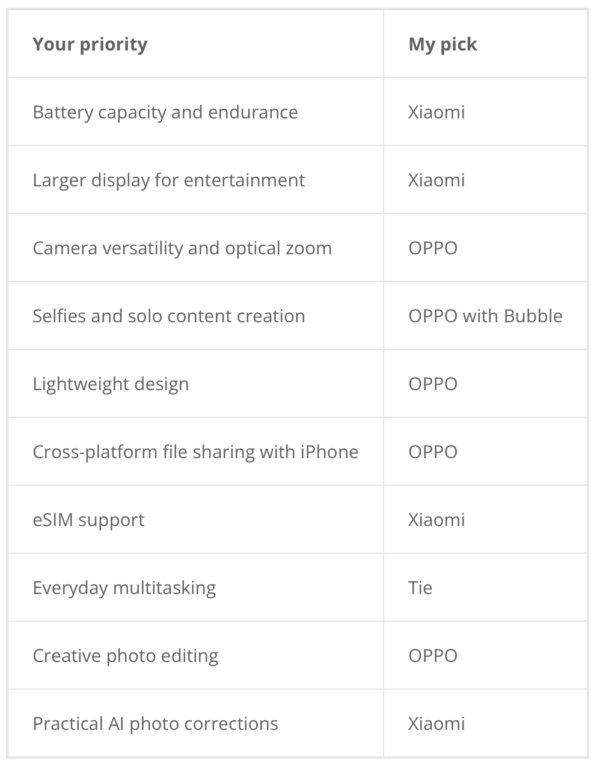
FINAL VERDICT: MY HEAD SAYS XIAOMI, BUT MY CREATIVE SIDE SAYS OPPO
Both smartphones made a compelling case for leaving my iPhone behind. The Xiaomi Redmi Note 17 Pro Max impressed me with its battery endurance, smooth everyday performance, and crisp photographs. I genuinely appreciated not having to worry about charging it constantly.
The Oppo Reno16 F appealed to a different part of my personality. Its versatile cameras, creative features, comfortable design, and excellent content-sharing options made it particularly enjoyable to use.
If I were choosing purely for battery life, entertainment, and getting through a busy day, I’d take the Xiaomi. After using both, I’ve realised that the best phone isn’t necessarily the one with the biggest numbers on its specification sheet. It’s the one that makes the things you do every day feel easier.
For more detail about my experience with Xiaomi’s battery life, charging, cameras, and performance, read my Xiaomi Redmi Note 17 Pro Max review and My Oppo Reno 16F 5G review.


Recharged is an independent site that focuses on technology, electric vehicles, and the digital life by Nafisa Akabor. Drawing from her 19-year tech journalism career, expect news, reviews, how-tos, comparisons, and practical uses of tech that are easy to digest. Nafisa is a traveller at heart, having been to 46 countries and counting. Find her edutainment videos covering tech, EVs and travel on TikTok.