
Discovery Bank and Visa have once again partnered to share consumer spend by credit card holders earning above R100 000 a year.
It sampled 1000 clients for the survey, with results that show travel spend has rebounded, the use of AI for shopping and a response to fraud, plus the use of weight-prescribed medications like GLP1s.
Hylton Kallner, Discovery Bank CEO says for the first time in years, they’ve seen a return to discretionary spending among South Africans, and that spend has outpaced inflation by close to one percent.
“Four rate cuts by the South African Reserve Bank in 2025 brought the prime lending rate down from 11.25% to 10.25%, and for the first time since 2022, consumer spending grew above inflation, by 0.8 percentage points,” says Kallner.
“The more important story, though, is behavioural. Rather than using that relief for additional discretionary spend, households are using rewards, budgeting tools and value-seeking strategies to stretch what they already have. This is discipline, not distress – and it gives us cautious optimism for how South Africans will respond to the pressures 2026 brings.”
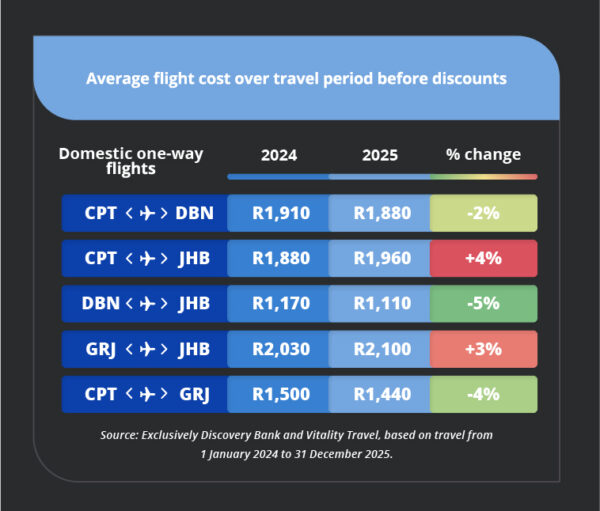
One such example is travel, which has rebounded across every income segment in 2025, with Discovery Bank customers making 18% more travel transactions than the average South African.
Kallner says value for money has become the single most important factor in travel planning, and that travel is no longer just about rest, it’s about getting the best deal.
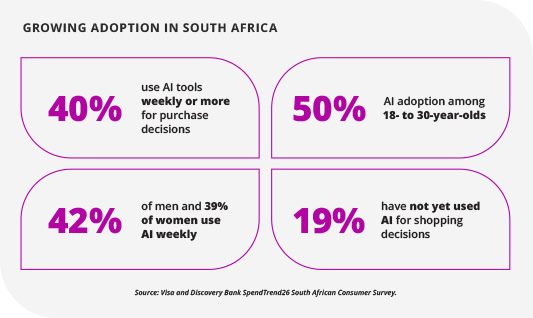
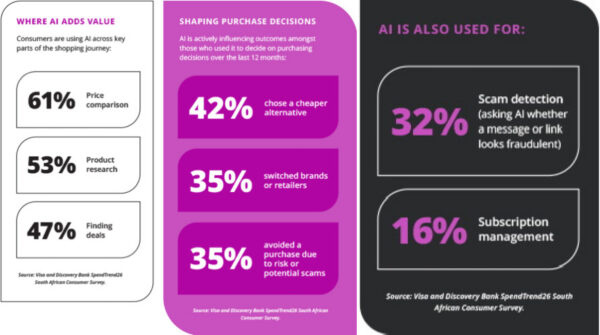
Another trend is AI in the shopping journey, and how consumers respond to fraud, he says. “40% of surveyed South Africans now use an AI tool weekly to decide what to buy, where to buy it, or whether to buy at all – rising to 50% among 18-to-30-year-olds.”
“Among those using AI, 42% found a cheaper alternative, 35% switched brand or retailer, and 35% avoided a purchase because of risk concerns. And 32% are now using AI itself as a fraud defence, asking it to check whether a message or link looks suspicious.”
And when it comes to weight-loss management, Kallner says health spending is no longer just a personal issue, it’s becoming a household financial decision with 14% of respondents saying someone in their household is using prescription weight-loss medication.
Among the 14% of respondents using GLP-1s, 59% say they are spending more on healthier foods, 48% less on takeaways and restaurants, 45% less on alcohol, and 38% less on groceries overall, he adds.
Lineshree Moodley, head of Visa South Africa says South Africa is not behind in the digital shift, in reference to the 200 markets Visa operates in.
“In fact, on several dimensions, we are genuinely world‑class, defined by how quickly we adapt, how confidently we adopt, and how effectively we leapfrog,” says Moodley.
“SpendTrend26 shows a clear step change in behavioural confidence. South Africans are increasingly choosing digital first when it is available, trusted and widely accepted, not because they have to, but because it works better for how they live, spend and manage risk,” adds Moodley.
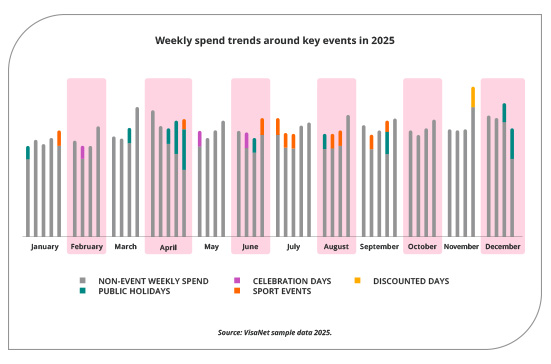
She highlighted that South Africans spend more on long weekends, celebration days and major sports events, and that Black Friday was the most important event in the spending calendar.
Here are the 10 key findings from SpendTrend26
- Spending edges past inflation. In 2025, consumer spending grew 0.8 percentage points above inflation for the first time since 2022, signalling a cautious but meaningful recovery. Four interest rate cuts by the South African Reserve Bank eased debt-servicing costs and freed up household income. Rather than increasing discretionary spend, households are using rewards, budgeting tools and value-seeking strategies to stretch their spending.
- Consumers are strategic and value-led on essentials. South Africans continue to prioritise essentials while adopting more value-driven behaviours – bulk buying, price comparisons, increased use of store brands, and active rewards engagement. Everyday food spending is shifting online, while dining-out and takeaway frequency are declining alongside a rise in home cooking, especially among millennials.
- Travel rebounds, and ride-hailing gains momentum. Travel spending rebounded in 2025 across all income groups. Value for money has overtaken relaxation as the top trip-planning factor. Fuel spending remained stable but grew more slowly, while ride-hailing usage is increasing faster than fuel spend, particularly among younger consumers. Electric vehicle adoption is growing but remains small, with EV charging accounting for less than 0.5% of total fuel payments.
- Small treats remain protected as budgets tighten. South Africans continue to prioritise small treats, reflecting mindful rather than reckless spending. Coffee purchases grew slightly in frequency and significantly in spend per purchase, reinforcing its role as a protected everyday ritual. Eating out and takeaways remain the most common treats; payday, discounts and the feeling of having earned a reward are the leading triggers.
- Cryptocurrency shifts from speculation to disciplined, steady investing. Mobile-first platforms have lowered entry barriers, especially for younger consumers. VisaNet data shows a shift from large, irregular trades toward smaller, more consistent purchases – signalling longer-term portfolio behaviour. Growth in transaction frequency is notable among middle-income groups.
- Online sports betting overtakes in-person gambling spend. Online sports betting now accounts for the majority of total gambling spend in South Africa. Among surveyed consumers who bet, more than half do so exclusively online. The behaviour is often event-driven, with many consumers setting and managing budgets deliberately.
- Prescribed weight-management medicine emerges as a new health spending category. Health and wellness remain a major spending priority – supplements, fitness, weight-management support and cosmetic procedures all feature. Among surveyed South Africans (credit card holders earning above R100,000 a year), 16% report spending on dieticians or weight-loss clinics, and 14% on prescribed weight-loss medications including GLP-1 therapies. Among the households using these medications, budgets are being meaningfully reshaped across healthier foods, takeaways and alcohol.
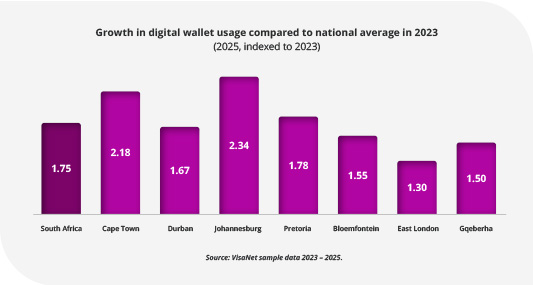
- Digital payments become the default as consumers stay vigilant against fraud. 94% of surveyed South Africans prefer card or digital payments; 85% hold a virtual card and 73% actively use one. Digital wallets account for 30% of in-store transactions nationally. As fraud threats evolve, consumers are adapting – 97% scrutinise messages before clicking any link, and 54% use virtual cards for new online merchants. Cash remains relevant for taxis, tipping, and situations where digital acceptance is limited.
- AI reshapes shopping decisions and the subscription economy. 40% of South Africans now use AI tools weekly to inform purchase decisions – mainly for price comparison, product research and deal-finding. AI subscription payment volumes grew 125% in 2025, becoming a significant category alongside e-commerce and streaming. Streaming’s share of the subscription mix moved from 67% in 2023 to 11% in 2025 as consumers shifted from passively accumulating subscriptions to actively managing them.
- Events and celebrations are a key driver of big spending. South African spend is strongly influenced by events – Black Friday, long weekends, celebrations and major sports matches. Black Friday drives a 57% uplift and now behaves as a month-long cycle, with appliances at +108%. Long weekends lift spend by 14%, with the April–May holiday cluster the strongest of the year. Celebrations drive a 15% uplift, with Valentine’s Day lifting spend at florists by 277%. Sporting events increase daily spend by 12%, concentrated in telecoms, refreshments and lodging.
Discovery Bank also shared five trends for 2026:
- Global energy disruptions are expected to lift fuel and food costs, intensifying value-seeking behaviours.
- Global trade shifts and tariff pressures are likely to weigh on consumer confidence and the cost of imported goods, and may slow the pace of further interest-rate relief.
- Health-conscious spending will continue to reshape grocery, dining and wellness budgets.
- Digital commerce and AI-assisted decision-making will become the default for value-conscious consumers.
- Event-led spending – such as the 2026 FIFA World Cup™ (11 June to 19 July 2026) – will drive material peaks in discretionary spend.


Recharged is an independent site that focuses on technology, electric vehicles, and the digital life by Nafisa Akabor. Drawing from her 19-year tech journalism career, expect news, reviews, how-tos, comparisons, and practical uses of tech that are easy to digest. Nafisa is a traveller at heart, having been to 46 countries and counting. Find her edutainment videos covering tech, EVs and travel on TikTok.