
The iCaur brand, a new energy vehicle adventure sub-brand under the Chery Group, is set to launch in South Africa in May 2026.
The first two electric vehicle (EV) models on offer will be the retro-looking V23 and a more modern 03T, followed later on by the V27 Range Extended Electric Vehicle (REEV). Originally, the 03T was shown off in China in April 2024 as the Jaecoo J6 on a trip Recharged attended with sister brand Omoda & Jaecoo. That vehicle is now rebranded and badged as the iCaur 03T.
The iCaur brand is currently rolling out a network of 20 dealerships across South Africa and will be independent of the Chery Group’s existing dealerships.
iCaur 03T EV
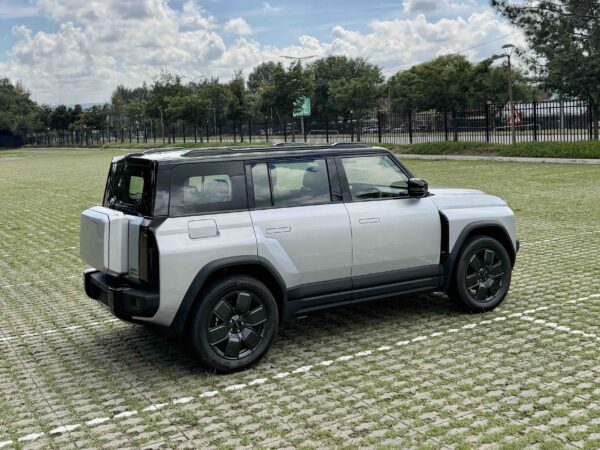
If you’re wondering why the 03T looks like a Defender, well I’ve got news for you. Chery in China has a joint venture with Land Rover and manufactures them for the Chinese market. It’s why the Jaecoo’s look like Range Rovers. Same same but different.
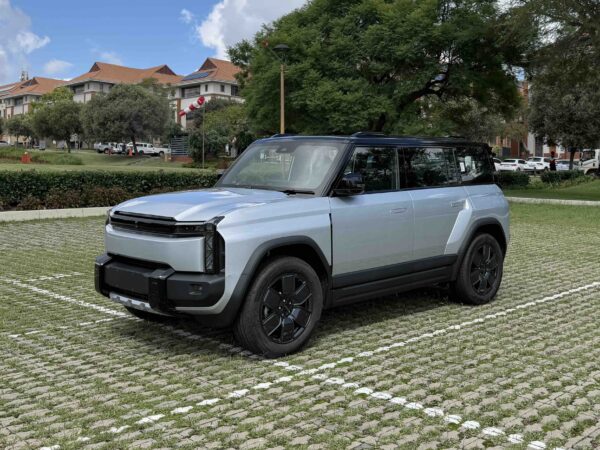
The 03T will come in two variants, a 2WD single motor and 4WD dual motor. The base 2WD model will have a 65.59kWh battery with 426km of range, and an output of 135kW and 220Nm of torque. It can go from 0-100km/h in 10.5 seconds and has a claimed energy consumption of 17.9kWh/100km. It will DC fast charge from 30-80% in 30 minutes, while its AC charging speed is 6.6kW.
The 4WD model will have a larger 69.77kWh battery with 418km of range, and an output of 205kW and 385Nm of torque. It’s also quicker at going from 0-100km in 6.5 seconds, while energy consumption is a claimed 19kWh/100km. It has the same charging capabilities as the base model.
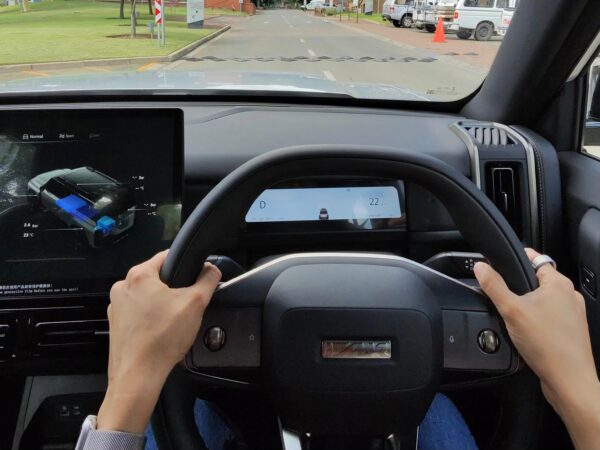
I got to briefly drive it in an office park at the Chery HQ where maximum speed is 40km/h so it’s not a true reflection of driving on the road. It’s silent and snappy as you’d expect from an EV with the usual Eco, Normal and Sport modes.
The cabin is modern and has a full colour driver display that is minimalist. As you can see, the steering wheel is not multi-functional so you can’t change the view of the instrument cluster – or if you can, I may have missed it.
The infotainment display is huge with various apps and touch controls for everything, i.e., there are no physical buttons for climate control. As seen on other Chinese vehicles, the car supports “intelligent” modes like Nap Mode, Love Pets Mode and Trailer Mode.
iCaur says high-specs come standard on the 03T range, which includes LED lights, panoramic sunroof, the 15.6-inch touchscreen with wireless CarPlay and Android Auto, and a suite of driver assistance systems. The sound system on the 2WD model has eight speakers while the AWD has a more powerful 12-speaker system.
The company says standard safety systems include a 540-degree camera, forward collision warning, lane keep assist, lane departure prevention and adaptive cruise control, among others. It has six airbags and ISOFIX child seat support, including additional stability systems like ABS, traction control and electronic stability programme (ESP).
iCaur V23 EV
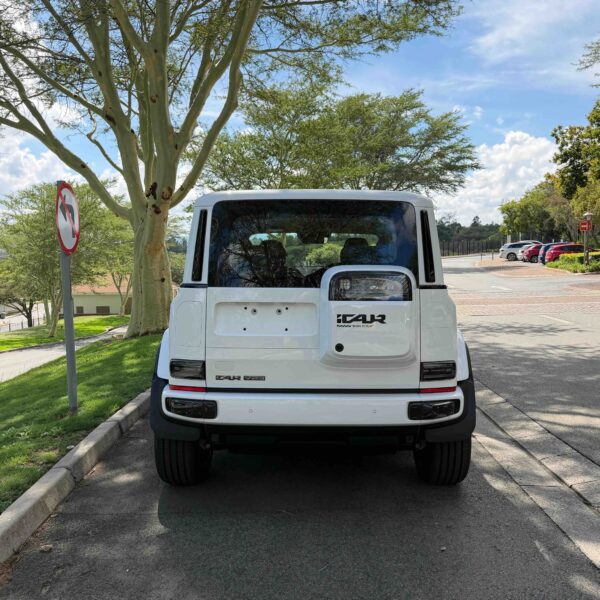
The iCaur V23 is more retro looking than the 03T, because it’s fully customisable. The V23 and upcoming V27 allows users to choose finishes thanks to its modular structure for adjustments to the panels, lighting and accessories without requiring special tools.
Users have complete control over how the vehicles look, which could be bold, futuristic or a clean retro finish, adapted to urban drivers, leisure or adventure travellers. It also features quick-release front and rear bumpers and side-hinged storage boxes that can be easily exchanged. It also means third-party accessories could be purchased to suit the customer.

There will also be two offerings on the V23, a 2WD single motor and 4WD dual motor. The base model 2WD has a 59.93kWh battery with 360km of range, and has an output of 100kW and 180Nm of torque. It can go from 0-100km/h in 11 seconds, while DC fast charging for 30-80% is 30 minutes. Energy consumption is a claimed 20kWh/100km.
The 4WD dual motor has the largest battery out of both models and variants, at 81.8kWh with 430km of range and has an output of 155kW and 292Nm of torque. It goes from 0-100km/h in 7.5 seconds and charges the same as the 2WD, while consumption is a claimed 22kWh/100km.
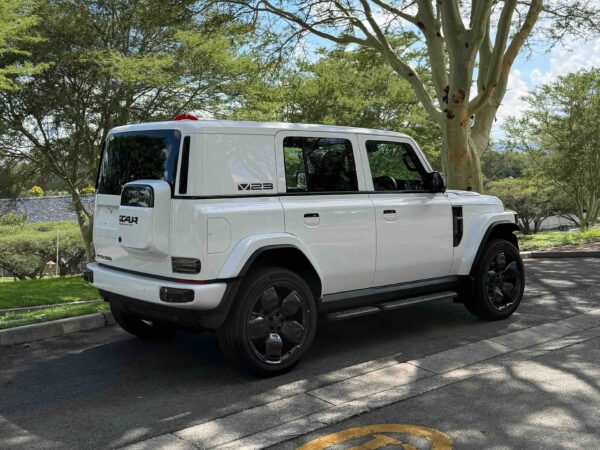
The V23 has an NFC credit card style key card that needs to be tapped in front on the side of the vehicle for locking and unlocking, which does sound futuristic but was not a fantastic experience on the Leapmotor C10; in fact is was frustrating. With these key cards, you have to place it in the NFC slot when you get in.
The interior also feels retro with some physical buttons beneath the infotainment system, which may be a good thing if you don’t like touch controls – I prefer climate controls to be physical buttons because it’s something I want to adjust instantly without fumbling into deep menus. It does not have a driver display like the 03T, which gives the impression that something is missing.
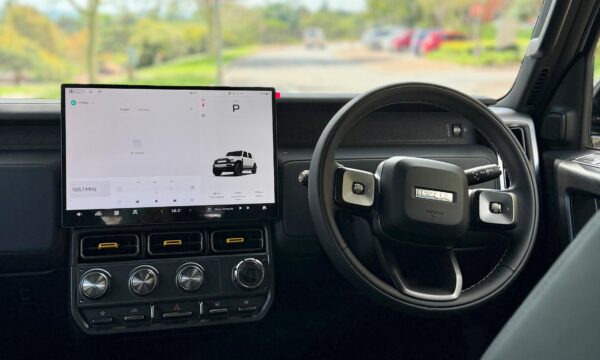
Other standard specs on both variants include leather seats, the same 15.4-inch touchscreen with wireless CarPlay and Android Auto, a 7-speaker sound system and safety package.
The safety specs include six airbags, ISOFIX child seat support, ESP and traction control. The AWD version has driver assistance features such as adaptive cruise control, lane departure warning, blind spot detection, and forward collision warning, while the 2WD is equipped with cruise control and a reverse camera. LED headlights are standard on both models.
I really can’t share much else due to the time spent in an office park at speeds of 40km/h and hope to spend more time in the vehicle at launch or for testing after.
iCaur Pricing
Initial thoughts are that they are great additions to the EV line-up in South Africa, also based on the price estimates provided by iCaur South Africa.
The iCaur 03T mode is estimated to cost around R680 000 to R750 000 between the two models, while the iCaur V23 is estimated to cost between R550 000 and R650 000.
More details, specs and warranty information will be shared at launch, otherwise visit the iCaur South Africa website.


Recharged is an independent site that focuses on technology, electric vehicles, and the digital life by Nafisa Akabor. Drawing from her 19-year tech journalism career, expect news, reviews, how-tos, comparisons, and practical uses of tech that are easy to digest. Nafisa is a traveller at heart, having been to 46 countries and counting. Find her edutainment videos covering tech, EVs and travel on TikTok.