
South Africa’s electric vehicle journey is picking up speed, and the charging infrastructure along one of the country’s busiest routes is already getting a serious power boost.
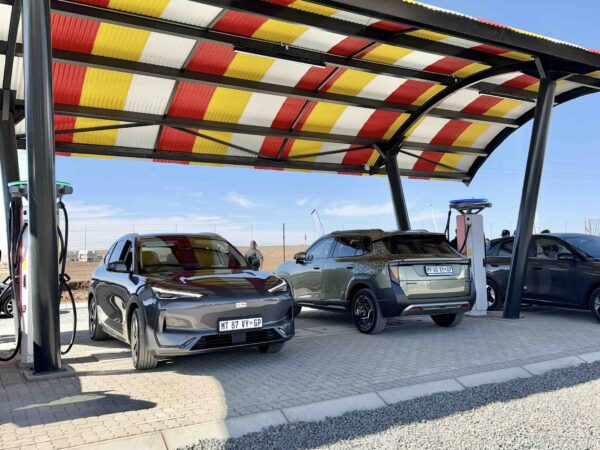
Just three months after launching its off-grid, solar-powered electric vehicle charging network on the N3 corridor, Zero Carbon Charge (Charge) has announced plans to double the charging capacity at both of its Charge Hubs.
Why the rapid upgrade? Quite simply, people are using them. Demand from drivers of electric passenger vehicles and commercial trucks has grown quickly enough for Charge to bring forward expansion plans that were originally designed to accommodate future growth.
TWICE THE CHARGING POWER
Each Charge Hub currently offers a total charging capacity of 360kW. Following the upgrade, that figure will rise to as much as 720kW per hub.
The system will automatically distribute available power between vehicles according to the number of EVs charging and what each vehicle can accept. When sufficient capacity is available, as much as 600kW could be directed to a single connector.
That opens the door to quicker charging for compatible vehicles, while allowing several passenger vehicles and electric trucks to plug in simultaneously.
Even when six vehicles are charging at the same time, Charge says each will have access to at least 120kW.
For drivers wondering what those figures actually mean on the road, a passenger vehicle charging at a constant 120kW could add roughly 150km of range in 15 minutes. At 400kW, that could increase to approximately 500km. An electric truck charging at 500kW could add around 75km during the same period, although actual results depend on the vehicle, battery, efficiency, and charging conditions.
MORE EVs, MORE DEMAND
“When we launched these hubs in May, we built them to accommodate today’s vehicles while leaving room to grow,” says Joubert Roux, Charge co-founder and chair.
It turns out that room is being needed sooner than expected. According to figures cited by Charge from NAAMSA, electrified vehicles now represent 6% of new light vehicle sales, with new-energy vehicle sales growing by more than 500% year on year.
As more South Africans consider making the switch to electric, reliable charging becomes one of the big pieces of the puzzle. Nobody wants a road trip that involves staring anxiously at the battery percentage and wondering whether the next charger is available, powerful enough, or even working.
Charge’s approach is to build that capacity ahead of demand rather than chase it afterwards.
SUNSHINE IS GETTING AN UPGRADE TOO
The expansion is not simply a case of adding bigger chargers.
Solar generation capacity at each site will increase by 66.1%, from 280kWp to 470kWp, while battery storage will jump by 117.1%, from 645kWh to 1.4MWh.
That larger battery bank will allow the hubs to store renewable energy for high-powered charging when sunshine is limited.
Together, the two upgraded hubs could generate approximately 1.6GWh of renewable electricity every year.
If all that energy went towards electric transport, Charge estimates it could support roughly eight million kilometres of passenger-vehicle travel or 940 000 kilometres of heavy-truck travel annually.
Put another way, that is close to 6 900 passenger-vehicle return trips or around 810 heavy-truck return journeys between Johannesburg and Durban.
CLEANER KILOMETRES ON THE N3
Charge estimates that the extra solar generation could avoid around 585 tonnes of carbon-dioxide-equivalent emissions each year compared with drawing the same electricity from the national grid. Once the expansion is complete, total annual emissions avoidance across the hubs could reach approximately 1,450 tonnes.
The hubs have already saved 24 400 kg of carbon emissions to date.
Roux says the bigger picture is about more than EV adoption. “It’s about displacing imported diesel and petrol with energy we generate here,” he explains, adding that the sites are expected to save around 800 000L of fuel directly.
For the freight sector, higher charging speeds could prove especially important. Michael Maas, CEO and Co-Founder of Zimi, says high-speed green charging can help move electric freight beyond pilot projects and towards becoming a commercially competitive option on the N3.
AND NEXT? THE N1
Charge expects to place orders for the N3 upgrades in the coming weeks, with expanded capacity targeted for completion before the end of the year.
Its next major rollout will turn attention to the N1 corridor, where the company plans to introduce megawatt-level charging capacity from the outset.
The lesson from the N3 appears fairly clear: build useful charging infrastructure, make it fast, make it accessible, and drivers will come.
South Africa’s EV revolution may still be young, but judging by the demand Charge is already seeing, it certainly isn’t standing still.


Recharged is an independent site that focuses on technology, electric vehicles, and the digital life by Nafisa Akabor. Drawing from her 19-year tech journalism career, expect news, reviews, how-tos, comparisons, and practical uses of tech that are easy to digest. Nafisa is a traveller at heart, having been to 46 countries and counting. Find her edutainment videos covering tech, EVs and travel on TikTok.