
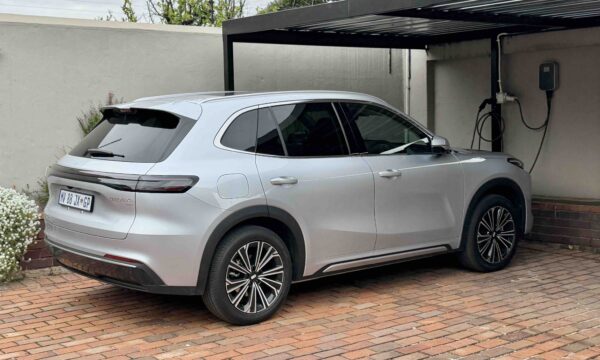
I recently spent a week driving the Geely E5 EM-i Apex, plug-in hybrid as part of my new Living Electric series. The car is available alongside a pure battery electric vehicle offering, the E5.
I will cover the practical aspects of driving NEVs in this series, made up of BEVs and PHEVs. It will feature information such as the charging situation, tech difficulties/ease, costs involved, etc. The first one featured the Lexus RZ 500e SE.
Geely E5 EM-i PHEV at a glance
- 1.5L petrol engine (73kW and 125Nm of torque)
- 18.4kWh battery (160kW and 262Nm of torque)
- Up to 943km of total range
- Supports Vehicle-to-Load (V2L) up to 6.6kW output
- 6.6kW AC and 30kW DC charging
- Price: R680 000
1. Who should buy this car?
Families who enjoy taking road trips plus have the school rounds. Business owners making longer commutes between cities and towns, and for couples who work close to home but love self-drive holidays, to take inter-provincial trips on a whim.
2. Range Reality
As a plug-in hybrid, the Geely E5 EM-i has a massive petrol tank combines with a 18.4kWh battery that kicks in when you need it, usually at take off until a certain speed or when you’re overtaking. You get a total theoretical range of 943km. That’s massive and I couldn’t even finish the tank in the week I spent with it.
But more importantly, as a hybrid, you can actively choose which mode to be in: battery, power/petrol or hybrid mode. When you’re in battery mode and run out, there’s always a 25% reserve you can’t deplete, saved for operating the vehicle. So when you recharge you will see it starts from 25% and never given access to 100% of that.
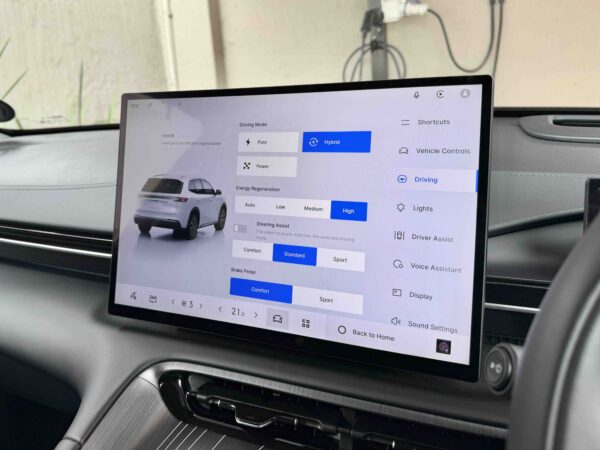
I preserved the battery for certain roads by switching to petrol (power) mode, like if you’re on a highway. I toggle this option based on where I was and if I wanted the battery for later if I didn’t get to charge it.
Driving on battery mode solely is also a bit risky if you deplete it and don’t get to charge it again fully. But overall, with close to 1000km at your disposal, you have nothing to worry about.
3. Home vs Public Charging
I charged the Geely E5 EM-i both publicly and at home. I did not receive a public AC charging cable with my test car, unfortunately, which meant, when I visited Hyde Park Shopping Centre, I couldn’t use the AC chargers as you need your own cable.
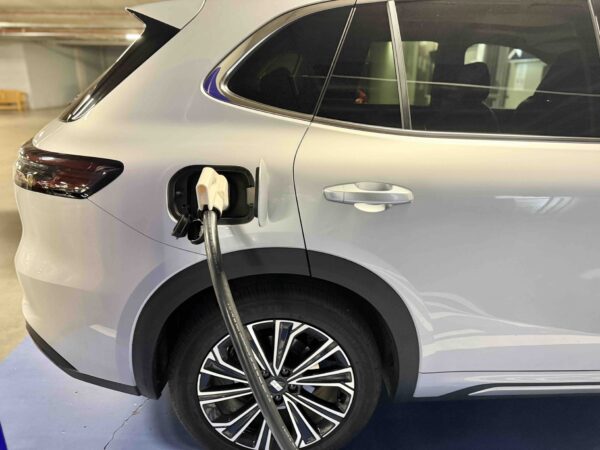
I did find this a bit frustrating as there were several opportunities I could have used an AC charger. That said, buyers of the Geely E5 and E5 EM-i hybrid get a free home wallbox charger.
I was supplied with a 3-pin plug charger, which I don’t need as I have a home wallbox charger.
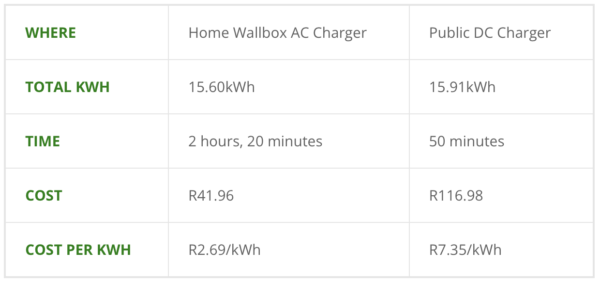
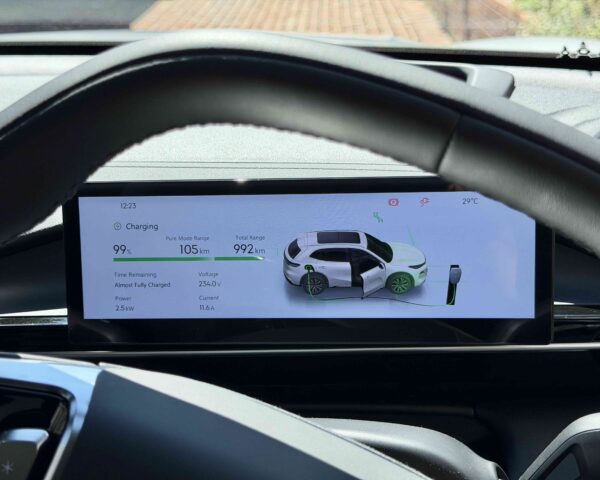
At home, my wallbox charger has a maximum speed of 7.4kW and as you may know, it does not charge at maximum speeds, it fluctuates. It took 2 hours and 20 minutes to charge the 18.4kWh battery, as mentioned from above from the 25% reserve to 100%. I did this during the day and I don’t have solar charging for it. My March 2026 rate wasR2.69 per kWh, which puts the cost to R41.96.
I charged the car publicly at a mall, which was a GridCars charger, and I have a GridCars issued card, so it was R7.35 per kWh on DC charging. The Geely E5 EM-i supports maximum 30kW DC charging speeds. But, as I’ve previously mentioned, you pay for speed publicly, hence the R7.35 rate. Had I used an AC charger, it would have been R5.88 per kWh, and the same 15.91kWh charge would have cost R93.55.
When it comes to PHEVs, they have a small battery alongside the engine, so it makes sense to charge it at home overnight or if you have the solar capability during the day, even better. I think charging on DC seems wasteful given the speed is capped at 30kW, which makes it expensive.
That said, PHEVs typically offer the option to charge the car from the petrol engine. With the E5, you have to manually go into the settings to activate this mode, which felt cumbersome. I drove a Lexus PHEV before and the button was on the centre console to directly switch to; I found that execution better.
Based on my testing, I started with 45km EV range and 853km of petrol, and when I got home, it was 61km EV range and 835km of petrol in the tank. This means 16km of EV range took 18km of petrol equivalent from the tank. I think it’s worth doing to take it to 50-75% of the battery if you really need to.
While I’m speaking about costs, I like to include how much it would cost to insure, using Naked as a reference, since I’m a paying customer of theirs and this isn’t sponsored. It will cost R1155 to insure the Geely E5 EM-i PHEV.
4. Living with the tech
The car has a large 15.4-inch infotainment system, powered by Geely’s Flyme operating system and 16 speaker system. It also has a head-up display (HUD) integrated into the windscreen, a panoramic sunroof, front seat ventilation and heating, and driver memory seat settings. With the HUD, you can adjust the settings to make it suitable for your height, plus the angle, and how bright you want it – rather nifty considering I adjust my seating position to be as high up as possible. If you’re into ambient lighting, you can change the hue.
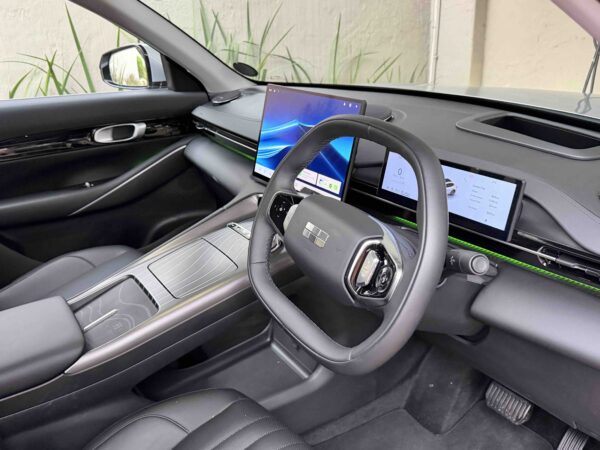
The Smartphone Test: I found it seamless to pair my iPhone to car and use my Google Maps as that’s the main reason I use this tech. There was no fumbling with the tech, where it would take multiple tries like in some other vehicles. With regards to Android Auto, it is meant to arrive in Q1 2026 by an over-the-air (OTA) update. The car supports wireless phone charging.
Physical vs. Digital: The E5 has a bit of both when it comes to physical buttons for climate control and using the touch interface. There is one touch access buttons on the centre console for the de-mister, rotating the air inside or from outside, turning the AC on and turning the fan on. The rest of it can be adjusted on the touchscreen, which isn’t my favourite. That said, beneath the main touch interface sits permanent buttons but they are also customisable, which is a great touch. You can choose what shortcuts matter the most to you. I chose driver seat heating, accessing the 360-degree cameras and fan speed.
5. Accessing driving data
Because this car isn’t a typical EV, you don’t really need this kind of info as the battery is just a small part of the car. But your current stats are always on the driver display. You can always see how efficient you are as it shows a summary of your current trip. This includes mileage, driving duration and average speed. Plus as you are driving you can see real-time consumption figures.
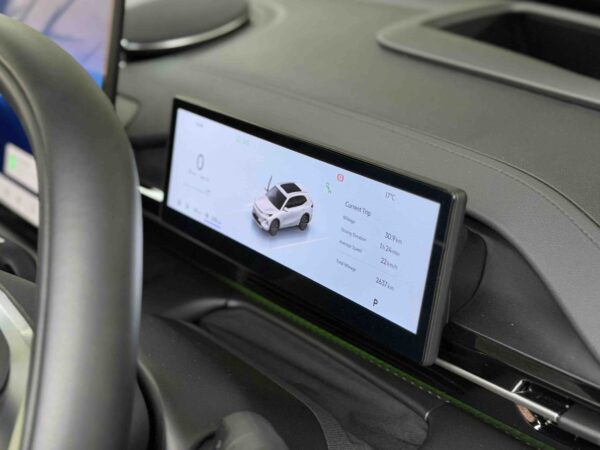
Based on my usage figures, my fuel consumption was 4.9L/100km and 6.5kWh/100km. Though, I do want to add this is the average for the car, and since it’s a test car, I don’t think I would have driven it as efficiently myself to have gotten those figures.
Officially, consumption figures are 6.2L/100km. I know how I drive and so I’m doubtful about the above figures being solely mine or combined based on it being a media fleet vehicle.
6. City driving vs. Open road
In the intro specs I shared at a glance, you would have noticed the two different outputs on the hybrid engine. The 1.5L petrol engine produces 73kW of power and 125Nm of torque, while the 18.4kWh battery has a 160kW and 262Nm of torque.
As expected, the battery is more powerful and why driving it on hybrid mode makes the most sense. While you can toggle to EV mode, I don’t think it’s a good idea to use often because you want the best of both worlds here.
The car drives best in hybrid mode, the take off feels powerful, as does overtaking, which you will notice whether you’re doing city driving or highway. When I depleted the battery and switched to power/petrol mode, I could feel the 73kW of power lacking, and it was difficult to adjust to. I didn’t even like what it sounded like at take off or trying to overtake.
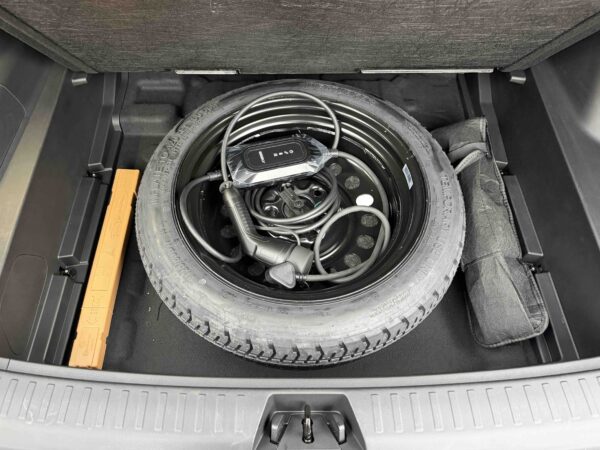
The E5 EM-i comes with a spare wheel in the boot, though it is not full sized. In comparison, the battery electric E5 does not come with a spare wheel. This is worth noting as Chinese vehicles typically don’t have a spare wheel.
7. Long-term view
Load-shedding readiness: I was surprised to see that the E5 EM-i PHEV supports vehicle-to-load and vehicle-to-vehicle with up to 6.6kW of output. This means, when there’s no power, you can use the 18.4kWh battery portion to power home appliances and, in the case of another EV running out of power, it can power another vehicle. This means you can run your washing machine, kettle, hair dryer, toaster on the vehicle, which to an extent, may make it appealing if you’re into camping.
Maintenance: Geely promises a 6 year/150 000km vehicle warranty and an 8 year/200 000km battery warranty. The hybrid comes with a 5 year/75 000km service plan, which is a bit different to the full E5 EV variant of 6 years/120 000km. Roadside assistance is unlimited for 5 years.
Geely appears to be offering a R5 000 charging credit voucher to use on public chargers.
8. Recharged Verdict
| Pros | Cons |
| Fuel efficient | Safety alerts intrusive; remember to switch off settings |
| Seamless between petrol and EV on hybrid mode | In pure petrol mode, it feels underpowered |
| 5 star Euro NCAP rating | |
| Spare wheel in the boot (not full size) |
Insight from a family member who bought the BYD Sealion 6 PHEV, a direct competitor to the Geely E5 EM-i PHEV. She likes that the E5 EM-i comes with a smaller size spare wheel in the boot, and that the boot space is larger while the legroom marginally smaller than her Sealion 6, which has a smaller boot but more legroom space for passengers. This was an interesting insight from a parent who clearly value more boot space than legroom for teenagers, who comfortably fit in the back passenger seats of both cars.


Recharged is an independent site that focuses on technology, electric vehicles, and the digital life by Nafisa Akabor. Drawing from her 19-year tech journalism career, expect news, reviews, how-tos, comparisons, and practical uses of tech that are easy to digest. Nafisa is a traveller at heart, having been to 46 countries and counting. Find her edutainment videos covering tech, EVs and travel on TikTok.