
I recently had the opportunity to spend more time behind the wheel of the GWM Ora 5 EV.
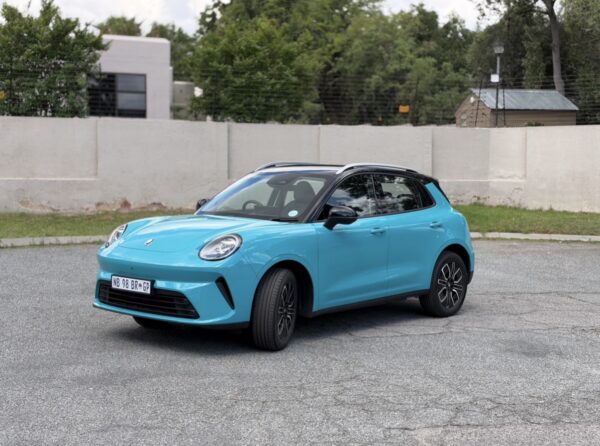
It’s a bit of a confusing one because the new model is called the Ora 5 but it comes in three derivatives: a petrol, hybrid, and full electric. You may recall I attended the launch event in Cape Town in July and I posted a TikTok about it if you prefer a quick visual update.
The brand did a lot of paid work with influencers, so you may have seen on social media that it costs R365 000, and while that’s not wrong, it’s the petrol one, which could be confused with the HEV or EV.
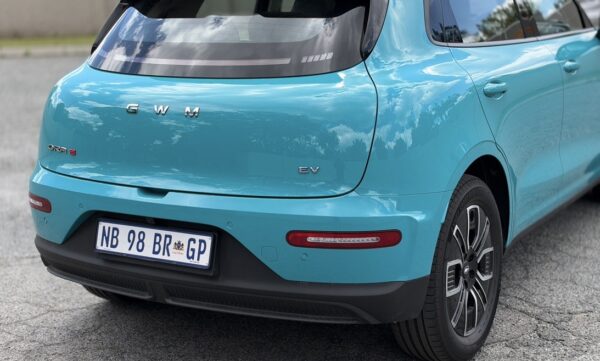
The full battery electric, or EV version that I spent time with, costs R599 900 for the Ultra Lux model. It is a R50 000 increase for extras over the Super Lux version of R550 000.
Both models have the same core spec, output and battery. The extra money is for comfort features. It comes in 8 fun colours including emerald, lake blue, pink, white, silver, grey, matte grey, black.
GWM ORA 5 AT A GLANCE
- 150kW of power; 260Nm of torque
- 0-100km/h in 8.0 seconds
- 58.3kW battery
- Around 440km range (WLTP)
- Max 120kW DC fast charging speeds
- Price: R599 900 as tested
The main difference between the Super Luxury and Ultra Luxury:
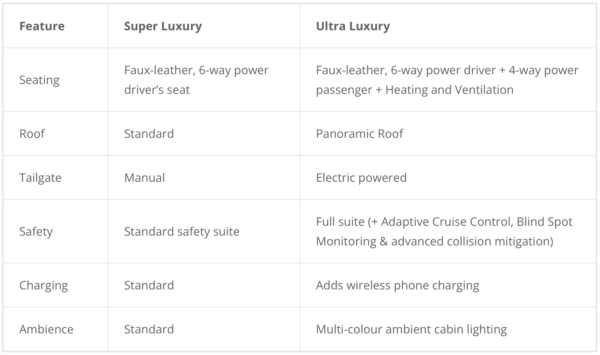
While you’re getting the same power and battery on both variants, the extra R50 000 is more for cabin comforts and additional safety features.
WHO SHOULD BUY THIS CAR?
GWM is very clearly going after the Mini driver, with its design, interiors, finishing touches, and colour options. It’s a fun car with personality that stands out from the same old.
So I’d say someone who wants a compact SUV, like the typical Joburg driver who also wants to drive around to nearby provinces. It would suit couples, young families or a one-person household.
One of the stand-out features for me is that it has a full spare wheel in the back. As a woman driving in Joburg, I think this is an important consideration, it just adds an extra layer of security.
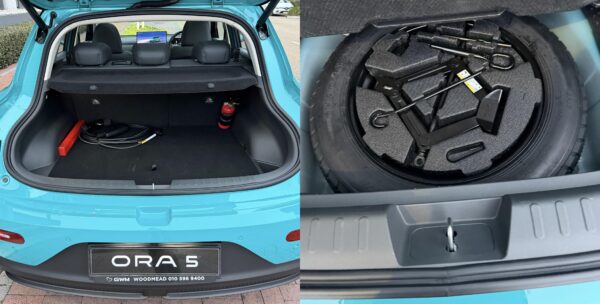
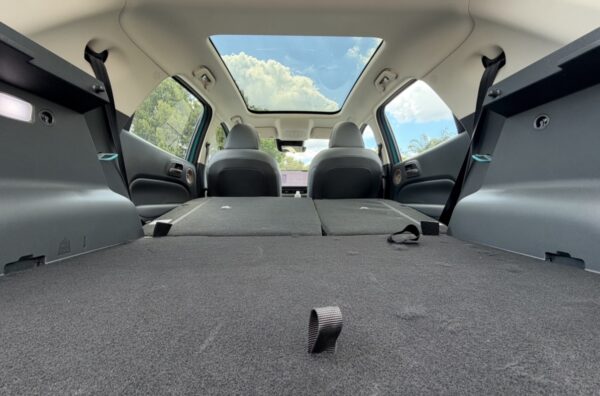
Speaking about the boot, it has 362L of boot space, which expands to 1060L when the back seats are folded down. It also features a false floor with two levels for flat loading or extra depth as needed. It would be cool if you want to star gaze through the panoramic roof or go to the drive-in (if you can find one today!). I also think GWM missed an opportunity to include a frunk.
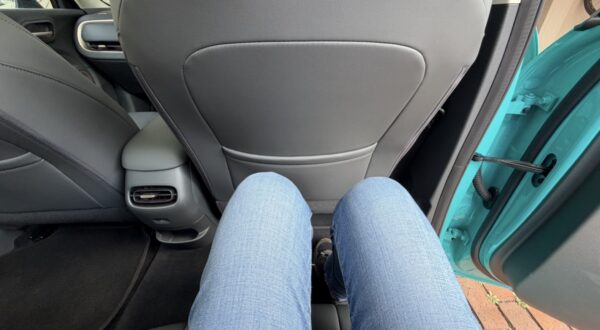
I also find this vehicle a bit more spacious than the Ora 3, especially with the amount of legroom in the back.
There was some controversy around the design when the original Ora 3 was released, designed by a former Porsche designer. There was some similarity with the VW Beetle as well, and on the inside, there are some similarities with the Mini. That said, the Ora 5 shares similarities with the Ora 3 despite Ora now having a different designer.
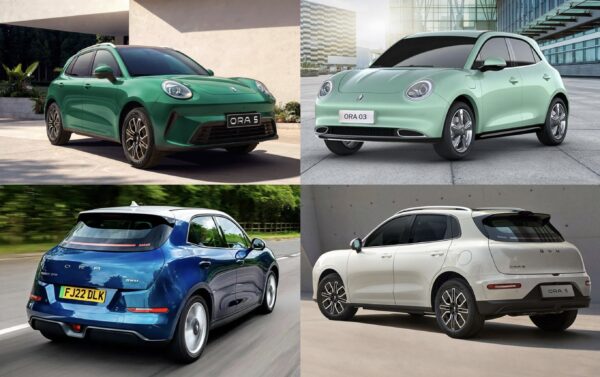
With the introduction of the Ora 5, GWM admitted it learnt from mistakes based on feedback from the Ora 3, which is why it’s no longer a compact hatch and now a compact SUV; so a lot bigger. It had a little design evolution as mentioned, and the pricing is much better but that’s because of how the market has changed. It also felt it was being held back by launching Ora as an EV-only brand, and why there are now petrol and hybrid options.
RANGE REALITY
When I received the car at 93% charge, the vehicle estimated 485km of range. And after charging for short bursts, when I eventually returned it the same day, I only had time to charge it to 80%, which showed 400km of range. Had I charged it to 100%, it would likely show more than 500km of range.
Officially, GWM shares NEDC calculations for its range for the Ora 5, at 520km; it’s what China uses. However, South Africa follows the EU standard and uses WLTP figures, which is a calculation that is a bit more conservative. The official WLTP figure is estimated to be around 435km.
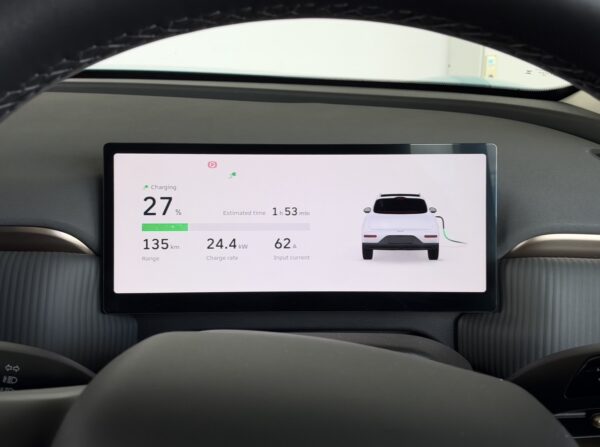
While the estimated range displayed on the vehicle is quite generous, my consumption figures of 16.6kWh/100km mean I would have got 350km of range, based on my driving style, while testing it. I drove it on the sport mode setting, made proper use of the heated and ventilated seats – you know Joburg and its crazy weather, and whatever other comforts it offered.
That said, if I drove around in eco mode in spring, I would likely have gotten way better consumption figures without needing to use the air conditioning or heated/ventilated seats.
HOME VS PUBLIC CHARGING
The Ora 5 comes with a home charging cable and public AC charging cables. There is no supplied wallbox charger that comes with the vehicle, customers would have to purchase a separate home wallbox charger if they want one.
I mentioned earlier, the Ora 5 has a maximum DC charging speed of 120kW, which I would say is a bit disappointing. But also, it is a relatively small-sized battery compared to larger EVs, but I think it should have supported 150kW speeds.
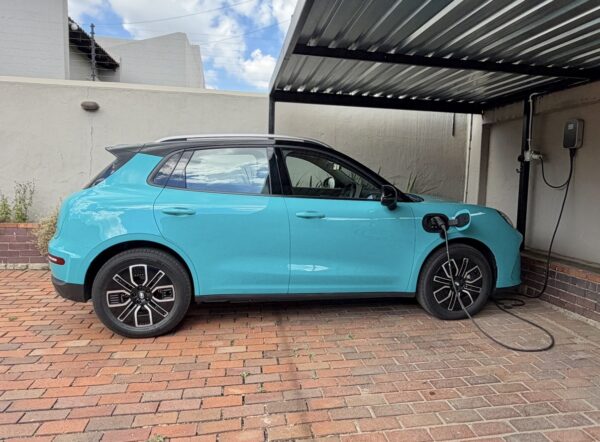
During my testing window, I experienced some issues with a Rubicon charger on the Ora 5 where after a short time of charging it, it disconnected. But I did have issues with the charger on previous occasions.
Rubicon support told me it was because I was using the Charge Pocket app and not their app. In the past, I used the Charge Pocket app (owned by Grid Cars) without having any issues. After they blamed the Charge Pocket app, I decided to give the Rubicon app a second chance as I once topped up and it refused to work so I had unused credits on it.
The support team assisted me with getting the app to work, only for the Ora 5 to charge for 9 minutes before randomly disconnecting. I was very frustrated at this point, so I drove off.
The reason I’m sharing this is that I cannot for certain conclude who was at fault here, whether it was the car or the app. But that said, I successfully charged the Ora 5 at a BMW dealership after, without having any issues experienced at Rubicon.
- Rubicon charge: 7.93kWh at R55.54 (R7/kWh)
- BMW Dealership: 37.42kWh at R303.79 (R8.11/kWh)
While those are my exact figures, here’s what it would cost to charge at home vs publicly, while using the full battery size to calculate.
As always, a reminder that one does not drain a battery to 0% before charging again:
- 58.3kWh at R2.69/kWh at home (Eskom) = R156.83
- 58.3kWh at R7.35/kWh at public DC charging = R428.50
- 58.3kWh at R5.88/kWh at public AC charging = R342.80
- 58.3kWh at R9.15/kWh at Zero Carbon Charge = R533.44
Realistically for a car this size, it makes sense to charge at home, via a home wallbox charger, otherwise to trickle charge it twice a week for a couple of hours. This is also an efficient way instead of charging from 20% or nearly empty.
LIVING WITH THE TECH
As mentioned in my launch post, the car has a bunch of great features as standard, like 360-degree parking cameras, tyre pressure monitoring system, reverse radar parking sensors, voice controls, 6 speakers and wireless CarPlay and Android Auto.
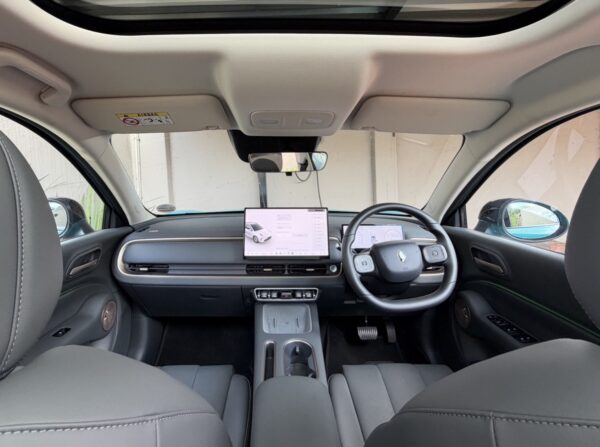
There’s also a 14.6-inch touchscreen and a 10.25-inch digital instrument cluster, USB-A and C slots in the front and another USB-C in the back. The infotainment system is powered by 7nm chip with 16GB of RAM and 128GB of memory and runs on GWM’s latest Coffee OS 3 operating system.
The system supports customisable widgets, a fixed dock for quick access vehicle controls, day and night display modes, and a quick settings page for most used controls.
Safety features include, but not limited to, six airbags (dual front, side curtain, front side), ABS, hill hold control, speed-sensing door locks, automatic unlock after collision, tyre pressure monitoring system and intelligent braking force distribution.
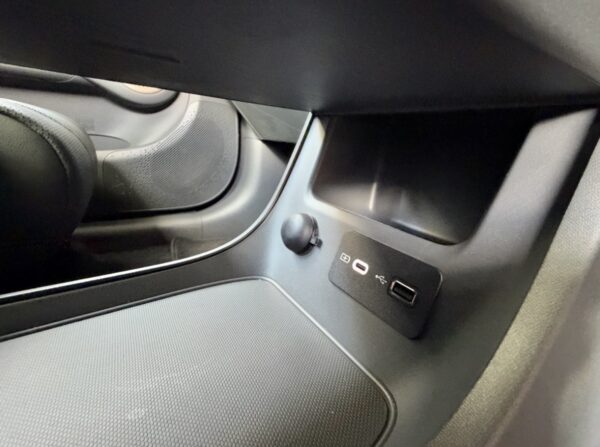
I found it easy to pair my smartphone to for Apple CarPlay. Apart from the USB-C and -A ports, it also has a 12V connection, should you need it. There’s an anti-slip mat by the ports to place your phone or other items.
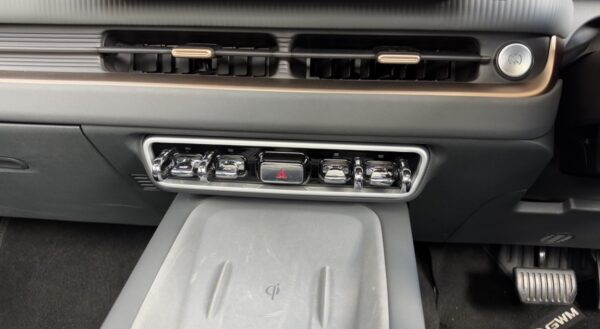
Most of the buttons that are physical are just flicks for certain features and not as functional as I liked. Such as physical buttons that look like it’s a Mini for things like the fan, air con, vent and auto settings. Flicking the switch up or down does nothing for the fan speeds, a missed opportunity.
I love that, on the Ultra Lux version I drove, there are memory seat functions to remember, which it can do for 3 people. The pano roof is pretty cool but the only way to control it is via the touchscreen and voice commands.
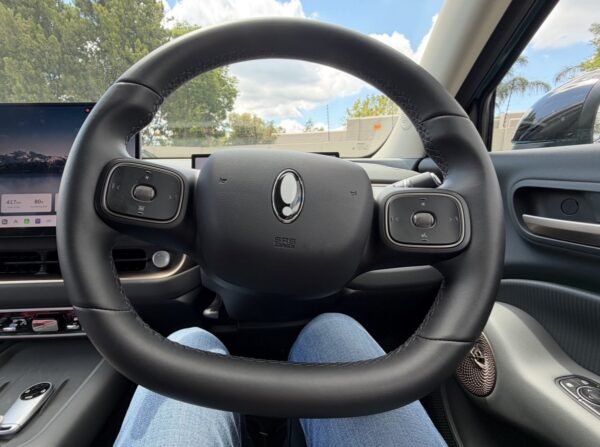
Because the car has a lot of the features tied to the infotainment display, it sometimes may be useful to use the voice commands. During my testing, I found that it doesn’t understand natural language. I had to ask it up to three times to perform a single function because of my phrasing. In 2026, voice commands should understand you in the way you speak.
Regarding the buttons on the steering wheel, I found them to be a guessing game to figure out what each one does. It felt like a trial and error because it was not well marked, but on each side you are allowed to choose a custom shortcut from the available options.
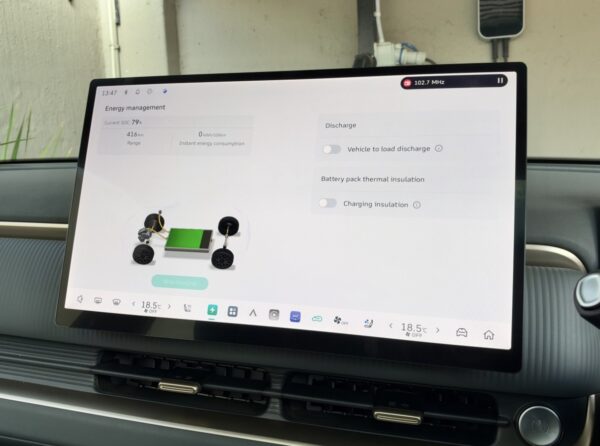
I want to point something else out here, the Ora 5 does not have cameras that monitor you inside the cabin, like in some other markets. It also added to my driving experience, as the car didn’t constantly beep when I looked at the infotainment display. This is one of my gripes with Chinese cars; the beeping when you look away.
ACCESSING DRIVING DATA
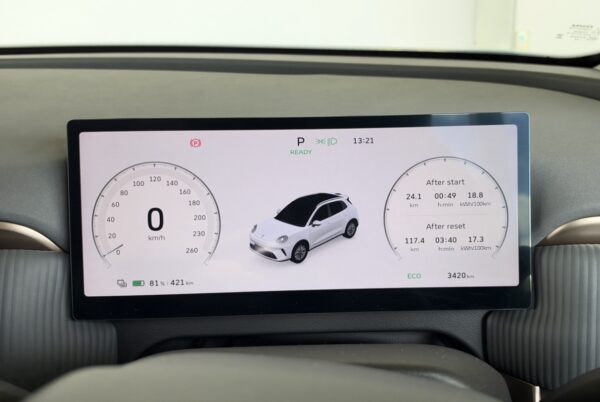
The vehicle’s driver display or instrument cluster behind the steering wheel shows you what your consumption figures are, provided you customise it to show you that data. It was my preferred edit for it, so I could always see at a quick glance what my stats were.
This information is not readily available inside the infotainment system, or if it was, it would have been hidden in some deep setting, but I do recall going through it and not being able to see your stats. I also find a lot of things tend to be hidden in the menus, which can be a bit overwhelming.
It brings me to a gripe I have, there is no South African GWM or Ora app available, yet. Some other markets have it but at the launch event, there was an update about it that it will likely get here in 2027. So, no concrete deadline on when it will be.
It would have been super useful to have it already, considering how tech advanced the car is and it would just make sense being able to glance at your driving data, assuming that’s what it would also cover.
CITY DRIVING VS. OPEN ROAD
Driving around urban areas, the Ora feels more at home doing so, given that it does a 0-100km/h dash in 8.0 seconds. It may not be super quick, but its 150kW of power and 260Nm of torque is adequate for city driving because it feels smooth and predictable.
I toggled between Eco, Sport and Normal modes but wasn’t quite sure how Well Being mode fit in. It’s supposed to give you a relaxed, stress-free drive apparently. I personally felt that toggling between sport and eco was sufficient for me. This can be done directly on the steering wheel, which is a nice touch for quick access.
Sport mode didn’t turn the Ora 5 into something I get from my Mini JCW, but it was more responsive when pulling away from the traffic lights or overtaking. That said, the suspension wasn’t as firm as on my Mini.
I found it comfortable to drive on the highway, the power is sufficient but it’s not as powerful as some other EVs I’ve tested, like the Volvo EX30. And that’s not necessarily a bad thing. The Ora 5 is more of an everyday comfortable EV rather than trying to pretend to be a performance one.
LONG-TERM VIEW
Load-shedding readiness: One of the coolest features about the Ora 5 is that not only does it support vehicle-to-load (V2L) to power external devices and appliances, but it supports it at 6.6kW outputs.
Most EVs in SA that support this feature, usually have it between 2-3kW or so. This becomes a massive “power bank” for your house or if our power issues ever return. Theoretically, it is capable of delivering 6600-watts if you ever need it. But don’t plug in your whole house at once, please!
Maintenance: The Ora 5 comes with a 7-year/200 000km warranty, 8-year/150 000km high-voltage battery warranty and a 7-year/75 000km service plan. Service intervals are at 12 months or 15 000km while roadside assistance is a standard 7 years.
RECHARGED VERDICT
The Ora 5 is a very appealing compact SUV in the electric space, aimed at those who want something beyond going from A to B to see immediate savings. It offers loads of tech and car for your money, plus for an extra R50 000, there are additional safety and comfort features sometimes found in premium vehicles.
Features like the spare wheel, two-level floor, panoramic roof and ventilated seats may as well be the drawcard. That said, don’t overlook the hybrid (HEV) variant with 164kW of power and 476Nm of torque for R425 000.
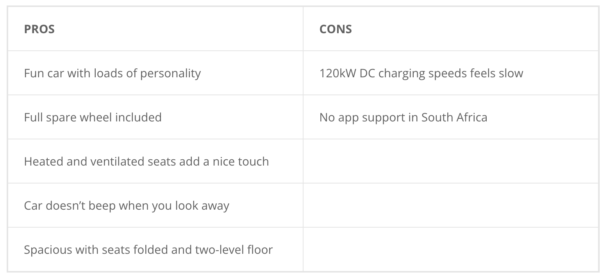
Buy it if… you want an EV that stands out, offers tons of features, decent range and a spare wheel.
Skip it if… you need faster charging speeds and more power because the Ora 5 is about comfortable daily driving than speed.
Living Electric: GWM Ora 5


Recharged is an independent site that focuses on technology, electric vehicles, and the digital life by Nafisa Akabor. Drawing from her 19-year tech journalism career, expect news, reviews, how-tos, comparisons, and practical uses of tech that are easy to digest. Nafisa is a traveller at heart, having been to 46 countries and counting. Find her edutainment videos covering tech, EVs and travel on TikTok.