

One of the largest airlines in the world recently announced the ban of power banks on-board. This is due to the batteries potentially overheating and becoming a fire risk. Earlier this year, power banks caught alight on flights in Hong Kong and South Korea.
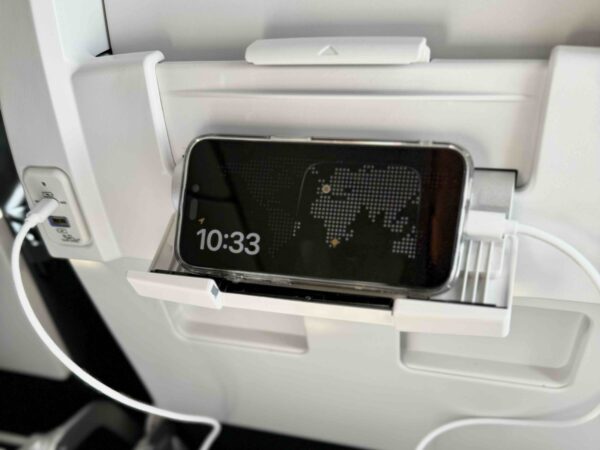
Emirates’ new rule came into effect on 1 October 2025, which prohibits the use of power banks on-board but there’s been a misinterpretation of this.
The emphasis being “using”, so you are allowed to carry your power bank in your cabin luggage, but it has to be in your personal item under the seat in front of you, and not in the overhead cabin.
A power bank cannot be used to charge your gadgets or be recharged in-flight, using the aircrafts USB ports.
The restriction on the size of the power bank is 100-watt hours (Wh). This translates to 27 027-milliamp hours (mAh). This has also been a long-standing TSA rule of not being allowed to carry batteries over 100Wh, so this limit is not a surprise as most travel bans are universal.
This is what Emirates says:
- Emirates customers may carry one power bank that is under 100 Watt Hours.
- Power banks may not be used to charge any personal devices onboard.
- Charging a power bank using the aircraft’s power supply is not permitted.
- All power banks accepted for transport must have capacity rating information available.
- Power banks may not be placed in the overhead stowage bin onboard the aircraft and must now be placed in the seat pocket or in a bag under the seat in front of you.
- Power banks are not permitted in checked luggage (existing rule).
I’ve been traveling on Air France a lot and on my last flight in August 2025, they also made announcements that one is not allowed to use their power banks on-board, and neither can it be charged on board.
As a frequent traveller, it’s also been a known rule that you cannot put lithium-ion batteries into your checked bags; I’ve always carried items with batteries with me, like hair tools and power banks. Customers will see the notifications at the check-in counters, and in some instances, you will be asked if you have any batteries inside your bag.
This also ties into the reason I don’t recommend buying a cheap cable or an unknown brand of power bank, you just don’t know how safe it is. Cheap power banks are risky, the brands that say heat is controlled to prevent overheating are the ones you should pay attention to.
I recommend, for example on iPhone, if the box says “made for iPhone” vs buying a R50 cable at the till point at a retailer.
If you’re not sure about the size, one of the power banks I rave about and bought a few of, is the Romoss PHC10 with built-in cables. It is 10 000mAh, nowhere near the limit of what’s not allowed.
Popular power bank sizes converted:
5 000mAh = 18.5Wh
10 000mAh = 37Wh
15 000mAh = 55Wh
20 000mAh = 74Wh
27 000mAh = 100Wh
A lot of Asian based airlines carry the same rule where you are not allowed to charge with a power bank or recharge it on the airline’s power supply, such as Singapore Airlines, EVA Air, Thai Airways, Vietnam Airlines, China Airlines, and Air Busan, plus US-based Southwest Airlines.
While this list is not the only airlines with restrictions in place, it is recommended that you check with the airline you are flying with, but it is safe to assume you cannot use it on-board but just carry it.
How to charge your devices safely in-flight:
- Carry your own cables (USB-A is recommended as most airlines still have these ports)
- Carry a USB plug for airlines that have sockets under the seat
- If you carry a plug with a USB-A and USB-C ports, then you can use any cable you have
Suggestion: USB-A to USB-C 66W fast charging from the Baseus brand for R99 at Bash or R129 at Clicks.


Recharged is an independent site that focuses on technology, electric vehicles, and the digital life by Nafisa Akabor. Drawing from her 18-year tech journalism career, expect news, reviews, how-tos, comparisons, and practical uses of tech that are easy to digest. info@recharged.co.za